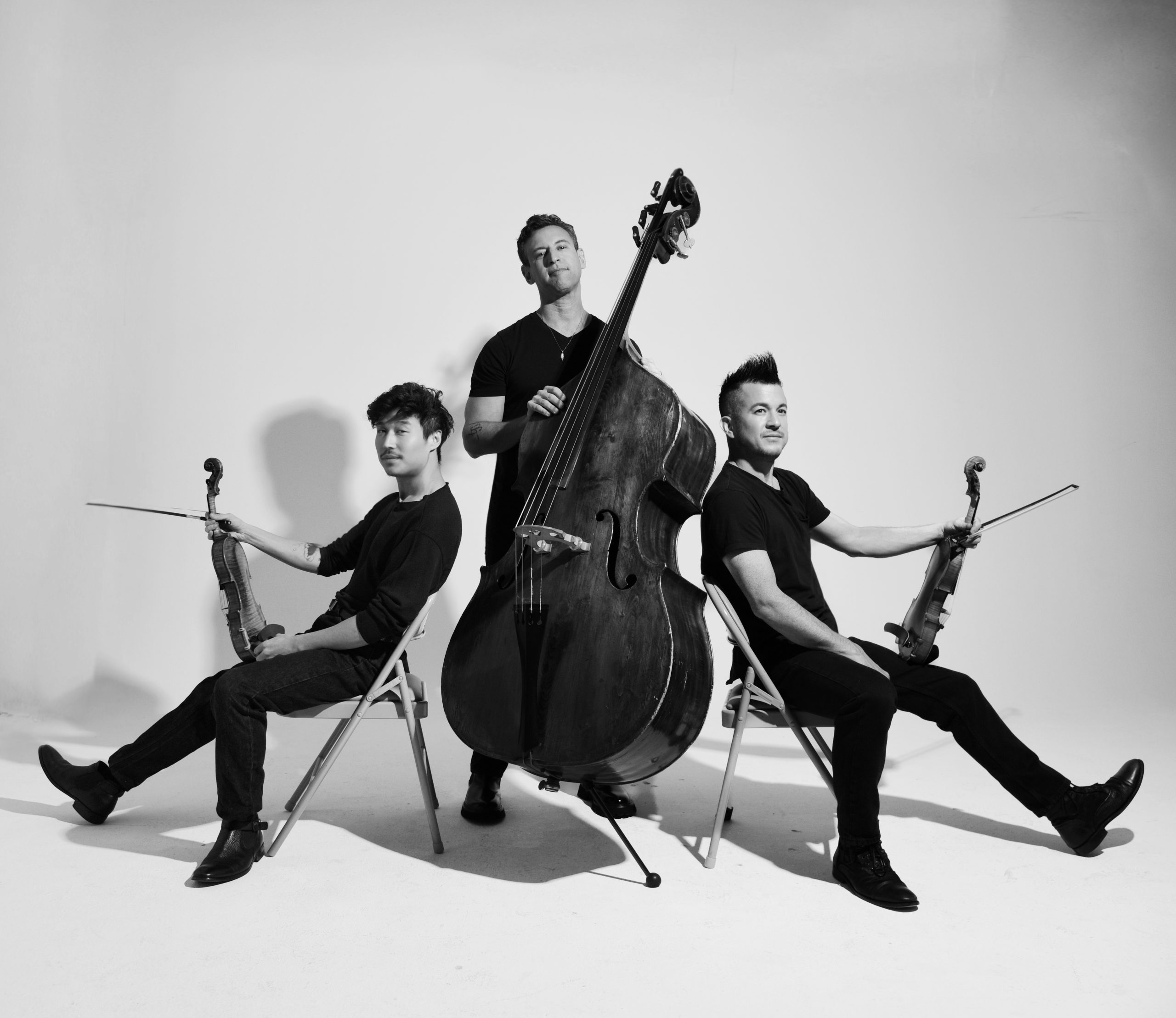
Pictured Above: Time for Three. Photo Credit: Shervin Lainez.
Time for Three Brings Boundless Musical Energy Back to the Princeton Festival
By: Lori Goldstein
Grammy-winning ensemble Time for Three returns to the Princeton Festival on June 18 with its signature blend of classical, jazz, bluegrass, and contemporary influences. Arts News Now contributor Lori Goldstein spoke with founding member Ranaan Meyer about the trio’s remarkable journey, creative collaborations, and upcoming projects.
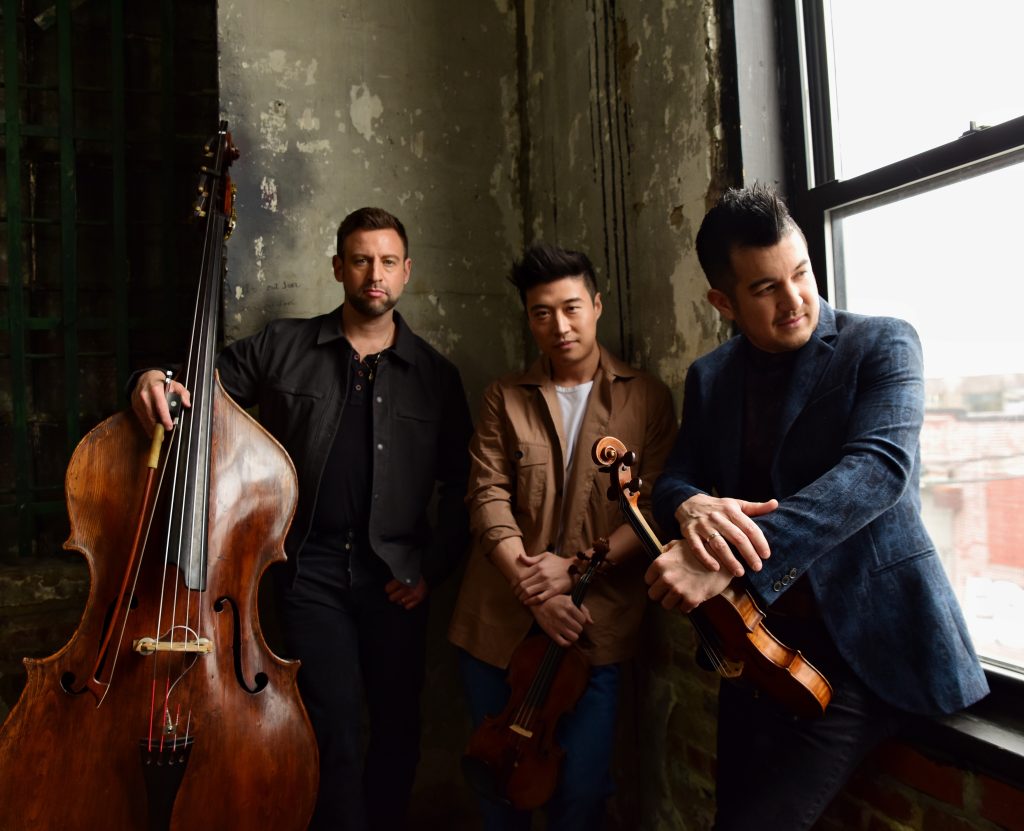
In the strings world, a trio ensemble implies the combination of piano, violin, and cello, or violin, viola, and cello. But a trio with two violins and a double bass? Unprecedented. And an ensemble that blends a unique mix of classical, bluegrass, rock, jazz, and hip-hop with its own vocals–that’s why Time for Three, familiarly known as T43, has garnered enough attention to win a Grammy as well as an Emmy Award in its 23 years. They’ll return to the Princeton Festival for what will be their third appearance June 18.
T43 originated at the Curtis Institute of Music in Philadelphia in 2003, where founding members Ranaan Meyer, double bassist, and Nick Kendall, violinist, had studied. In 2016, Juilliard violinist Charles Yang joined T43 when founding member Zach DePue left to become concertmaster of the Indianapolis Symphony Orchestra.
As a spokesman for T43, Ranaan Meyer catches me up to speed on their latest ventures. In their first years as an ensemble, they had only the repertoire that they wrote or arranged themselves. However, now their work with preeminent contemporary composers and conductors is the catalyst for their fast-paced career. Meyer recalls the time when they were performing at a Philadelphia Orchestra fundraiser. T43’s originality caught the eye and ears of conductor Christoph Eschenbach, who “fell in love with what it was we were doing. He called us into his office to try to shape our lives, and we all agreed it was time to have an inspired composer write a concerto for us.” That composer was Jennifer Higdon, whose Blue Cathedrals they had just played at Curtis. “She had won a Pulitzer Prize and three Grammys, and we were just these green kids that had a lot of energy. She really was a mentor to us.”
In 2007, Higdon composed Concerto 4-3 for them, and Meyers recalls that Higdon was “logistically aware. She’s very entrepreneurial, so in addition to being a great composer, she knew ‘if I write it this way, it may not get played by a lot of orchestras. But if I write it in a different way, I think we might get this played a lot.’ That was important because she wanted to empower us with a piece that we were going to be able to play for years.”
Another fortuitous collaboration was with composer Kevin Puts, whose 2022 work Contact was recorded along with Concerto 4-3 in the “Letters to the Future” album, the trio’s first recording with Deutsche Grammophon. Conductor Xian Zhang led the Philadelphia Orchestra, resulting in two Grammy awards: Best Classical Instrumental Solo and Best Contemporary Classical Composition for Puts’ Contact. Composed during the pandemic, Puts wrote that “the word contact has gained new resonance during these years of isolation. It is my hope that this concerto might be heard as an expression of yearning for this fundamental human need.”
Pictured Above: Time for Three. Photo Credit: Shervin Lainez.
Puts drew on the theatrical and vocal talent of T43 for his next project, Emily, No Prisoner Be: a 26-movement song cycle set to the poetry of Emily Dickinson–featuring mezzo-soprano Joyce DiDonato, who created the role of Virginia Woolf in Puts’ opera, The Hours.
Meyer describes their process during the 10 days of studio recording: “Each day Joyce would read a poem slowly and carefully before we would even get into the music recording portion of it. And it was like our North Star. We would take the essence and the feeling of this. We would even drive home what maybe one destination word feels like emotionally or character, discuss it, maybe even debated a little bit. And then as we put it into the music, we would listen for these really special moments and in the way that Kevin wrote to it.
It’s the 25th movement of Emily, No Prisoner Be that really affects Meyer emotionally. “It’s all a cappella, and it’s hard to breathe, let alone sing. And Joyce says [Emily’s words], ‘If I could just help one heart, If I could just change one heart.’ What we believe as a group [about] what this poetry means…is that even after somebody is doing something so horrible…that it takes even more bravery, courage, to forgive them. The irony is, even if you’re the victim, you have this obligation to show them that they can be better.”
The premiere of Emily, No Prisoner Be occurred at the Bregenzer Festspiele in Bregenz, Austria in August 2025. Subsequent performances were in February 2026 at Chicago’s Symphony Center, in DiDonato’s hometown of Kansas City, and at New York’s Carnegie Hall. “We’re touring it again in Europe in August, and in the States in October 2026,” says Meyer.
A flurry of commissions will keep T43 touring through 2028. Their fifth concerto will be released in the spring of 2027. Composed by Mason Bates, who combines electronica with the orchestra, the fifth will highlight Yang on mandolin in two movements, and each member of T43 singing extensively. In July 2027, they’ll premiere their sixth concerto at Festival Napa Valley. Its composer is Michael Thurber, who’s received several Tony awards for his orchestrations. And there’s a seventh concerto waiting in the wings, though Meyer’s not at liberty to give details about it just yet. However, he does remind me that one of their earlier concertos was written by Chris Brubeck, the son of Dave Brubeck. “It’s a jazz concerto in four movements, [during which] he goes throughout the history of jazz,” says Meyer.
Besides their globe-trotting performance career, T43 has managed to do over 2000 educational workshops in schools since the ensemble’s inception. Honeywell Arts Academy in Washbash, Indiana, is their summer “home.” As its founding artistic director, Meyer established the program in 2008 so that every student goes there on full scholarship. Its inspiration is Alasdair Neale, music director of Idaho’s Sun Valley Summer Symphony, where T43, as artists-in-residence, first met Kevin Puts with Alasdair’s encouragement.
At the end of my conversation with Ranaan Meyer, he has this to add: “I just want to say one more thing about Princeton and how special it is to us. Every time we play, we just feel a type of listening environment. And the energy from the festival, a love for Rossen Milanov, it’s a gorgeous festival.”
Another Princeton Festival performance you’ll want to attend: The June 19 concert Great Ladies of Jazz, which stars Capathia Jenkins and Aisha de Haas. The premier vocalists will pay tribute to Ella Fitzgerald, Sarah Vaughan, Billie Holiday, Judy Garland, Ginger Rogers, among others. This evening will feature many of the greatest hits from the Great American Songbook. Lucas Waldin returns to conduct the Princeton Symphony Orchestra for this performance.
The Princeton Festival is running from June 5th to June 21st – find the performance schedule and get tickets at: princetonsymphony.org/festival
 Independent Arts News Reporting