Independent Arts News Reporting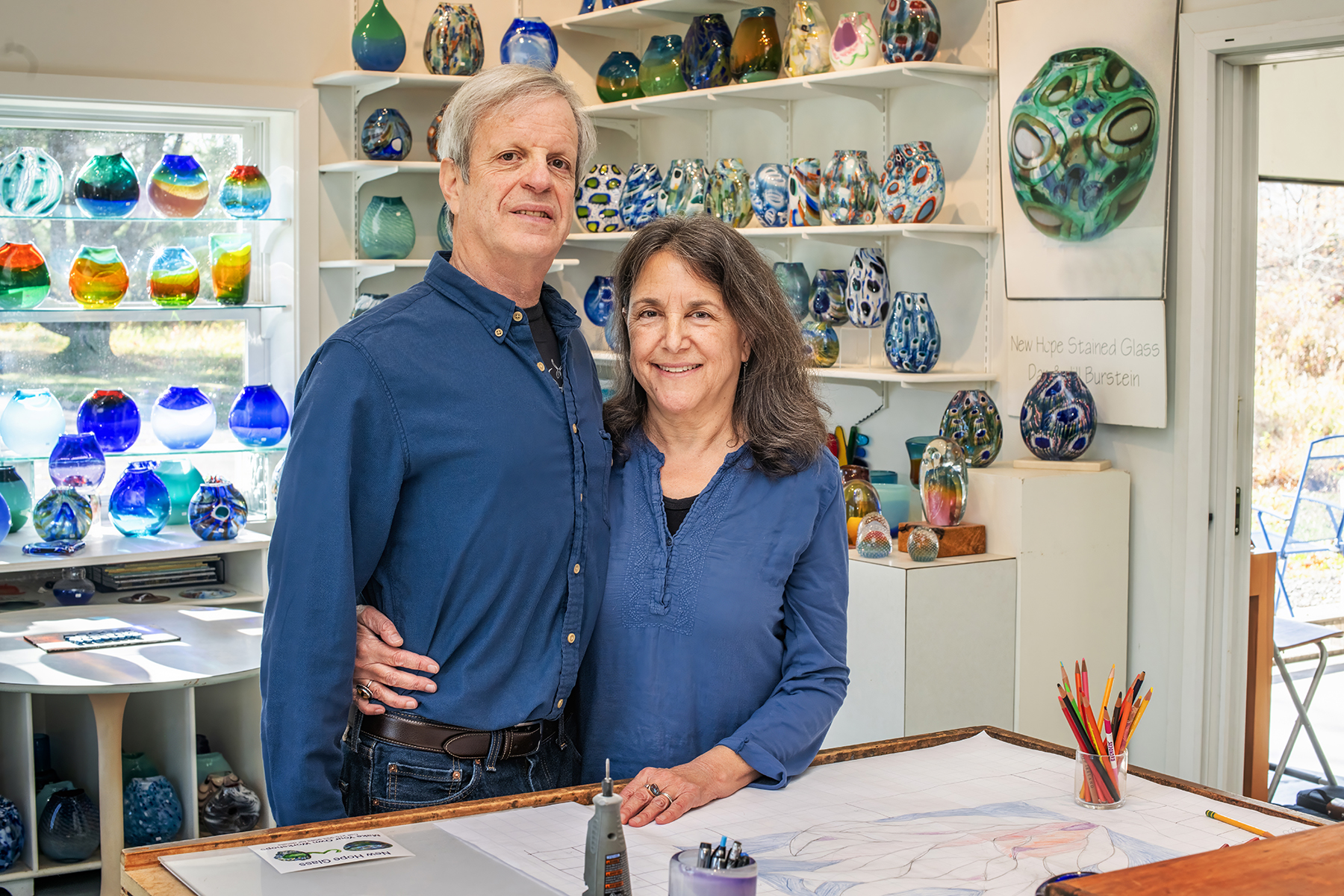
Pictured Above: Dan and Jill Burnstein in their New Hope, PA studio. Photo Credit: Kristina Gibb.
A Life in Glass Art: Craft, Color, and Collaboration in New Hope
By: Chrysa Smith
Arts News Now’s feature writer, Chrysa Smith visits one of New Hope’s most mesmerizing studios that’s hiding in plain sight. The New Hope Stained Glass Studio, where design and fabrication come together quite naturally. The husband-and-wife team behind it all share an interest in beauty, nature and the visual arts, which they combine to create exquisite blown and stained glass.
Dan and Jill Burstein are at it daily. Turning raw materials into exquisite works of art. They say that’s one of the secrets behind their 44-year marriage – a joint love of landscapes, nature, creation, and the ability to work side-by-side in their New Hope studio. Located on the grounds of their Sugan Road property, Jill has her design space; Dan his production/fabrication space. Together, they work their craft.
The couple spends about half their time with blown glass; the other with stained glass— two very different animals. Blown glass is created using tools, a furnace, a reheating chamber and cooling chamber to form a desired object. It’s shaped, colors are added to the clear glass. The color comes in rod form or glass frit (powder form).
On the other hand, stained-glass comes in colored sheets in a rainbow of shades. Jill has her design drawn out on a sort of drafting paper as a template. Individual pieces are numbered—their own form of map that tells them where they fit into a design. Purchased from a glass shop, and for each project, the sheets are selected, cut and fit into a copper form. This is called the copper foil method. Both types of glass work are beautiful. Both are time-consuming. And together, they make up New Hope Stained-Glass.
You may not know too many glassblowers. In fact, Dan took up glassblowing later in life, maybe by accident. He worked in what he calls the horse business for 30 years. But after the children moved on, something was calling to him. Living in Rochester, NY for 15 years, Dan and Jill visited the Corning Museum of Glass. He took a class there, and with no experience, made a blown glass flower. “This sparked my interest in glass,” Dan says. So, in 2000, when they moved to New Hope, he saw an ad for a glassblowing class at Bucks County Community College, in Newtown, PA. Dan says. It was quite a popular artform back then. In fact, it was difficult to get into a class. So, he first took stained glass making to gain some credits, which gave him a solid working knowledge with glass. Jill, with a background in sculpture and design, said he came home and said they’d make stained glass together. And so it began.
At first, Dan says he was looking for a hobby. But as they got into it, and gifted pieces to friends and family, word got around, and they began receiving requests. Once the kids left, he wanted to do something different, something home-based. So, that experience with stained glass making led to an interest in blown glass. His glass-blowing teacher at Bucks, Carl Carter was an early mentor. He was the guy responsible for Dan learning the craft, enjoying it, starting it. Unfortunately, once Karl left, the program eventually ended. As with cycles, interest in the craft fell off, but according to Dan, a revived interest in blown glass has caused a resurgence in programs at colleges—offering four-year degrees. Carl always recommended going home and experimenting, as well as taking lessons at other places. So, during time off from school, Dan took classes at the Corning Museum of Glass. One two-week class led him to meet his most current mentor, Davide Salvadore. He influenced Dan in his venture, teaching him to make Murrini glass—an Italian tradition. Dan experiments with creating diverse sculptural and functional forms out of glass using intricate Murrini patterns or images made in a glass cane.
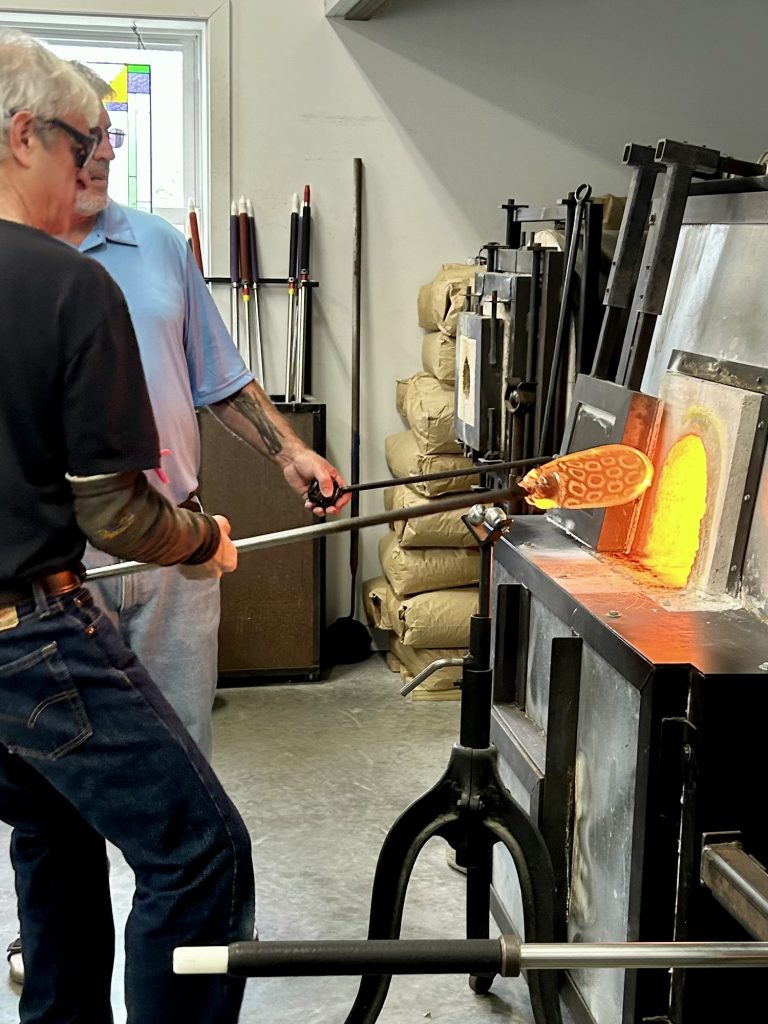
Pictured Above: Dan Burnstein in studio. Photo Credit: Jill Burnstein.
Dan’s love of nature has inspired two of his blown glass series: Landscape, where he layers the colors of the earth and sky in organic compositions; and Ocean Waves, where he depicts the simultaneous calmness and turbulence of the water’s movement. Jill adds that one of their other popular lines is called Peacock. Taken from the bird’s beautiful plumage, designs resembling feathers in beautiful shades of greens, blues and brown come together in a striking manner.
All of Dan’s blown glass pieces are one-of-a-kind, due to color, density, pattern, transparency of the glass. Even if you try to use the same colors and design, each piece will be slightly different. “Wholesalers have to make everything identical, but I’m a colorist,” Dan says. “What excites me most is interaction with the colors.” On multi color objects, Dan says the variations come from colors ‘fighting ‘each other. The way they come together forms a pattern. Colors are bought in cylindrical forms, in kilos, from Germany. A saw is used to cut off pieces. Most of their pieces are done in variations of colors in blues/greens. Not only does Dan say there is most variety and selection in these colors, but “I love these, and my inspiration has always been nature. I went to lots of parks and museums as a kid. Nature and art were always in my mind. I released my inner art early.”
So, exactly how does it all work? Three days a week, Dan works in the studio blowing glass. It’s an intricate process that involves taking molten glass, heating it in a furnace which contains a crucible that holds it. Using a variety of tools, the molten material is then turned and formed into the object of desire. If it is perfect, great. It goes into a cooling chamber, where it sits for 14 hours. Dan’s furnace, powered by propane gas, runs at about 2000 degrees. The intensity of the heat allows the forming to be done. If the object needs some refining, it goes into a reheating chamber, raising the temperature just a bit, and allowing more forming to be done before cooling. According to Dan, you have about 45 -50 seconds before the piece begins to cool by hundreds of degrees, making it reharden. It’s all a fascinating process that fuses design knowledge, raw materials, fabrication, tools and patience. And it’s all available for you to see in their studio.
When not glassblowing, the rest of the week is spent making stained glass pieces. While there are some landscape pieces off the shelf, most of their work is custom-made—stained glass windows, arches and other architectural details or hangings. They recently worked on a project for a Lutheran Church in Sunbury, PA, designing 13 panels. And work for the Shir Ami Temple in Richboro, PA, and the Penn State Health Milton S. Hershey Medical Center.
New Hope Stained Glass belongs to the Pennsylvania Guild of Craftsmen, The Stained-Glass Association of America and The Glass Association of America, and their work can be found in several galleries including the Red Tulip right in New Hope. Commissioned pieces for mainly residential use are available, and on display in their studio. They take part in the fall Covered Bridge Artisans Studio Tour, the Yellow Springs Art Show in the spring and will be doing a pop-up along with Diana Contine, a local jewelry-maker, on May 2nd, from 10-4pm at the studio on 3420 N. Sugan Road in New Hope.
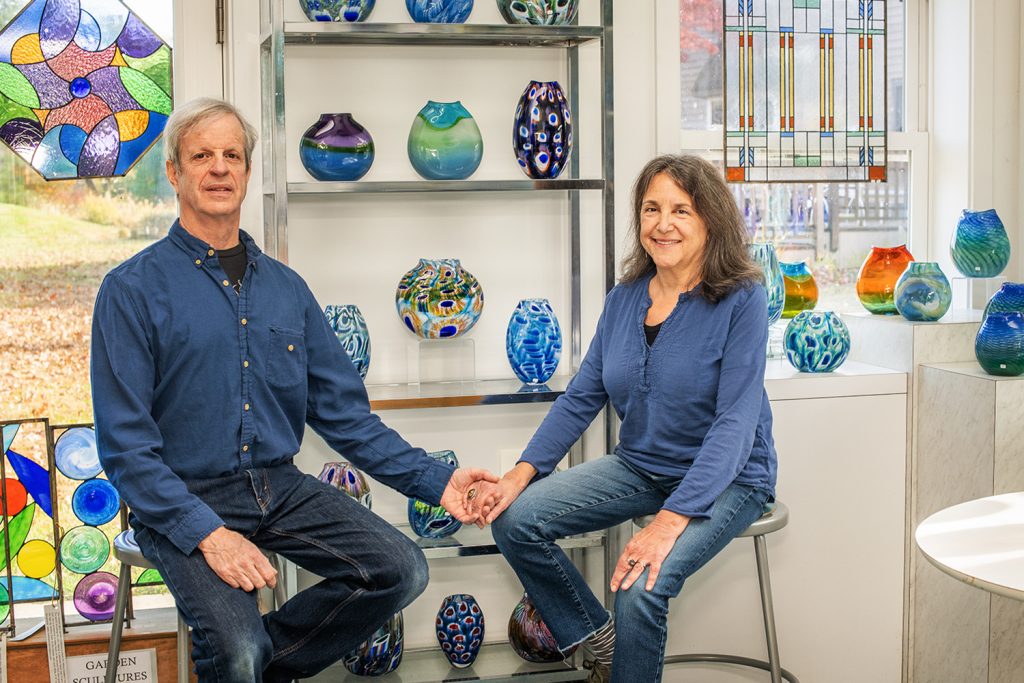
Pictured Above: Dan and Jill Burnstein in their New Hope, PA studio. Photo Credit: Kristina Gibb.
If creating blown glass has piqued your interest, you can drop in to watch the process— even make your own flower or bowl. If you’d rather purchase a finished piece, visit them. Or check their website for gallery locations.
Find Out More:
New Hope Stained Glass
3420 N. Sugan Road
New Hope, PA 18938
215-297-8498
danglassartist@gmail.com