 Independent Arts News Reporting
Pictured Above: The hallway within Chaplin’s former family home, the Manoir de Ban in Corsier-sur-Vevey, Switzerland. Photo Credit: Chaplin’s World™ © Bubbles.
Where Art Becomes Home: Chaplin, Hammerstein, and the Power of Preserved Legacy
By Mandee Hammerstein
Founder & Editor, Arts News Now
Most of us know the art long before we ever know the artist.
I’ll admit — with a mixture of honesty and regret — that this was true for me when it came to my grandfather-in-law, Oscar Hammerstein II. When I first began working in theater more than fifteen years ago (prior to meeting my husband, Will Hammerstein), a colleague excitedly told me about an upcoming Hammerstein-themed event we’d be working on together. Seeing my pause, she offered a helpful prompt: “Hammerstein — you know… The Sound of Music. Do-Re-Mi?”
And suddenly, everything Oscar Hammerstein clicked.
Not atypical, I realized I had grown up immersed in his work — singing “Oh, What a Beautiful Mornin’” on sunny days, dramatically belting “I’m Gonna Wash That Man Right Outta My Hair” through teenage heartbreaks, winding up my Edelweiss music box as a young one before bed. The music had always been there. The man behind it, less so. Today, I’m a mother to my own Oscar, carrying that legacy forward in ways I never imagined.
That realization would later shape my understanding of what museums can — and should — be.
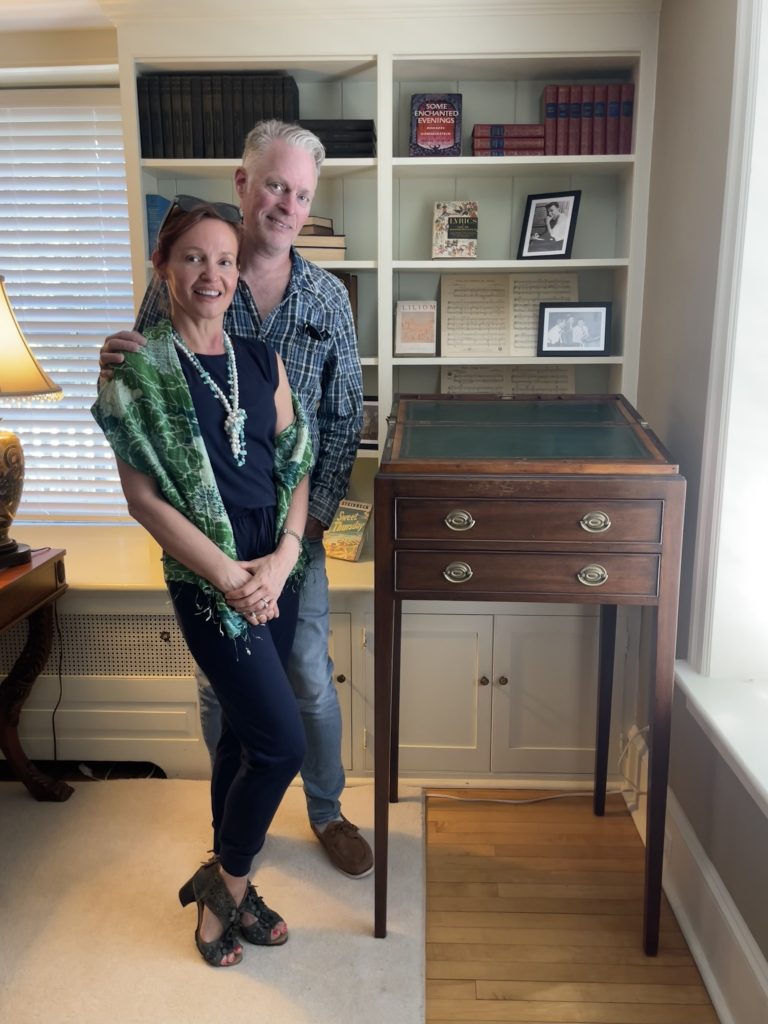
Pictured Above: Mandee K. Hammerstein & William Hammerstein stand in Oscar Hammerstein’s original study by Oscar Hammerstein newly donated (2025), famous desk at the Hammerstein Museum where he wrote his beloved musicals at Highland Farm in Doylestown, PA. Photo Credit: Contributed.
Building a Museum Is an Act of Faith
Years later, my husband Will and I found ourselves deeply involved in the effort to save Highland Farm, Hammerstein’s former home in Doylestown, Pennsylvania, and transform it into the Oscar Hammerstein Museum & Theatre Education Center. The journey was long and often exhausting: years of fundraising, community outreach, zoning hearings, neighborhood appeals, board formation, and countless volunteer hours.
Along the way, we were reminded — sometimes bluntly — that museums are often dismissed as financial liabilities rather than community assets.

Pictured Above: Mandee K. Hammerstein & William Hammerstein gather with local officials, donors, board and committee members at Highland Farm, celebrating the launch of a fundraising campaign in 2018, Doylestown, PA. Photo Credit: Bucks County Courier Times.
I’ll never forget with our Hammerstein Museum committee celebrating a hard-won fundraising milestone at a local pub with when a real estate investment networking group overheard our excitement and made their way over. Upon learning about our efforts and wins, they were quick to tell us, with no small amount of mockery, that “museums are “money pits” and a “waste of time…” As someone who also works in real estate, I couldn’t help but push back. My words were along the lines of “Cultural institutions don’t just preserve history — they drive tourism, strengthen civic pride, elevate property values, and generate sustained economic activity. The data backs it up, from National Endowment for the Arts reports to the widely cited “Bilbao Effect…” and proceeded to close with, “I will be looking forward to receiving your generous donations when you see your investments outpace your original projections upon this museum opening.”
Still, the doubt lingered.
Why keep going? Is my time, my husband’s, our board’s, and the committee’s time, etc., better invested elsewhere?
The answer had little to do with nostalgia and finance and everything to do with values.
A Culture of Kindness
As I learned more about Hammerstein, I came to understand that his art was never separate from his ethics, his values. He believed deeply in what I often call a culture of kindness — using creativity not to preach, but to illuminate.
Beyond his music, Hammerstein:
-Dedicated an hour each day to philanthropic causes
-Worked with Eleanor Roosevelt on fair housing initiatives
-Co-founded Welcome House with Pearl S. Buck, supporting interracial adoption
-Supported relatives displaced by Japanese internment
-Advocated tirelessly for civil rights and artistic integrity
His legacy was not just lyrical — it was human.
Which is why, when my family visited Chaplin’s World in Corsier-sur-Vevey, Switzerland, this past spring, I was unexpectedly overcome.

Pictured Above: A collage inside Chaplin’s former family home, the Manoir de Ban, Chaplin’s World. Photo Credit: Contributed.
Chaplin’s World: Everything We Hoped For
Set within Chaplin’s former family home, the Manoir de Ban, Chaplin’s World is the rare museum that feels both intimate and expansive. Envisioned in 2000 by architect Philippe Meylan and museographer Yves Durand — and in close collaboration with the Chaplin family — the site was officially saved in 2008 and the preservation process finally began for an official opening to the public in 2016. Chaplin’s World artfully preserves the very place where Chaplin spent the final 25 years of his life creating, composing, writing, reflecting, while hosting friends from around the world.

Pictured Above: The interactive Studio just steps away from Chaplin’s Manor. The studio houses wax figures, interactive exhibits related to Chaplin’s film, history and advocacy. Photo Credit: Chaplin’s World™ © Bubbles.
The museum unfolds in two parts: the Manor, which captures Chaplin’s private family life, and the Studio just steps away, an immersive, cinematic journey through his creative universe. Walking through the rooms where Chaplin thoroughly lived and aged into wisdom is especially moving.

Pictured Above: Inside Chaplin’s World’s Studio, steps from the Manoir de Ban. Photo Credit: Contributed.
Per Chaplin’s World, the museum has become one of the most visited cultural destinations in the Lake Geneva region, drawing families, film lovers, students, international travelers, and locals alike — with a measurable impact on tourism and the surrounding economy. Yet what lingers most is not the scale, but the emotion.

Pictured Above: Life size wax figures of Charlie Chaplin and his wife, Oona O’Neill within the Manoir de Ban in Corsier-sur-Vevey, Switzerland. Photo Credit: Chaplin’s World™ © Bubbles.
Chaplin’s genius, like Hammerstein’s, lay in his ability to confront fascism, racism, displacement, and inequality through art that felt accessible, funny, and deeply humane. His work reminds us that laughter and empathy can be powerful tools for change.
As Olivia, my PR contact at Chaplin’s World, beautifully shared: “Chaplin’s World is more than a museum — it is a place of discovery, fun, and emotion. It reminds us that a man who spoke to the world without words still has something essential to say today.”

Pictured Above: The interactive Studio just steps away from Chaplin’s Manor. The studio houses a theater, story-telling, life-sized wax figures, interactive exhibits related to Chaplin’s film, his history and advocacy. Photo Credit: Chaplin’s World™ © Bubbles.
Why Museums Matter — Now More Than Ever
Chaplin’s World is not just a tribute to a singular artist. It is a living example of what happens when preservation, creativity, and community align. It stands as proof that museums are not relics of the past, but investments in empathy, education, and economic vitality. Both museums faced similar timelines and paths of resistance, becoming realities years later through enduring faith and resilience.
Standing there with my husband and son, and seeing the inspiration and awe amongst the guest’s faces at Chaplin’s World, I had admiration with clear remembrance: that this is what we hoped for when we worked to save Highland Farm.
Not to present perfection — but purpose.
As museums can bring us together, they also serve to remind us who we are, what we value, and what kind of future we want to build. They are places where art becomes home, and where kindness — once set in motion — continues to echo across generations.
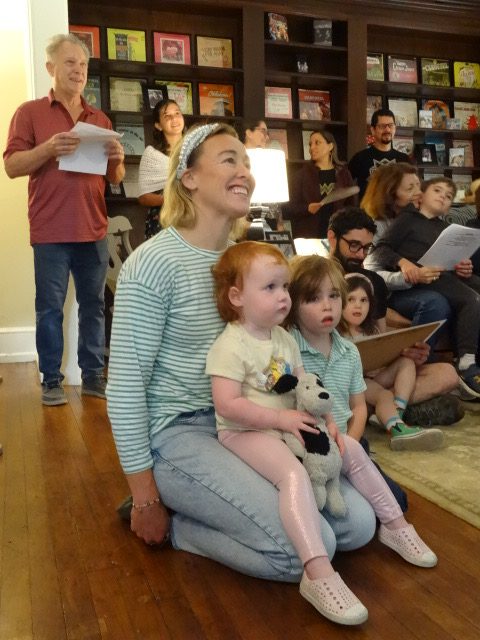
Pictured Above: Families gather for a sing-a-long in Oscar Hammerstein’s living room at Highland Farm at the Oscar Hammerstein Museum & Theatre Education Center. Photo Credit: Contributed.
Plan your visit/s or learn more:

Pictured Above: Visitors get to step into each room of Chaplin’s home, including his restroom, experiencing playful views of the artist as himself through wax artistry at Chaplin’s World™ © Bubbles Incorporated. Photo Credit: Contributed.
Chaplin’s World
Corsier-sur-Vevey, Switzerland
To visit Chaplin’s World in Corsier-sur-Vevey is to walk through the rooms where humor, exile, love, and resilience quietly coexisted. Special events and daily tours for groups and individuals are welcomed.
chaplinsworld.com
Oscar Hammerstein Museum & Theatre Education Center
Doylestown, Pennsylvania
To experience the Oscar Hammerstein Museum & Theatre Education Center is to step inside the home of a lyricist who believed music could soften hearts, expand empathy, and help shape a more just world. Private and public tours, plus various programming events for all ages are readily available.
The author and her husband, Will Hammerstein, were involved first-hand in the early preservation and founding efforts of the Oscar Hammerstein Museum & Theatre Education Center, working alongside board members and volunteers through 2019. After helping establish effective systems and community leadership, they stepped back from formal roles. They continue to fully support the museum and collaborate with its leadership when appropriate.