
 Independent Arts News Reporting
Pictured Above: Tora Nogami Alexander, Morgan Morse, and David M. Lutken. Photo Credit: Ben Hider.
How "The Porch on Windy Hill" Grew From a Pandemic Idea Into a Beloved, Soul-Stirring Play
By: Keith Loria
Award-winning journalist Keith Loria explores how”The Porch on Windy Hill” has blossomed into a deeply resonant theatrical experience that blends heartfelt storytelling with old-time music. What began as a small idea shared over Zoom and long car rides has grown into a beloved play with music, inviting audiences to lean in, reflect on history and family, and discover unexpected harmony.
The Porch on Windy Hill, now playing at urbanStages through Feb. 22, carries with it a story that is as much about its own creation as it is about the characters who gather onstage. Developed during the isolation and uncertainty of the pandemic, the play has grown—organically, communally and musically—into a work that continues to resonate with audiences across the country.
Morgan Morse, co-writer and one of the performers, remembers the show’s origins clearly.
“It was late winter, early spring of 2021,” he said. “Everything was still just starting to open back up after the first vaccines and nothing felt certain. At the time, Sherry Stregack Lutken and David M. Lutken were slated to do a different production at Ivoryton Playhouse, but pandemic restrictions made that impossible.”
Then came a pivotal phone call. The artistic director asked the Lutkens if they had a show with no more than three people and all public-domain music and they told him they would get back to him.
That was the initial seed of The Porch on Windy Hill, and during a long car ride to the grocery store in Louisiana, where the two were staying at the time, they talked through an idea.
“And then they thought of me and Lisa Helmi Johanson and called us up and said, ‘Do you want to try to write this thing?’ And both said yes,” Morse said.
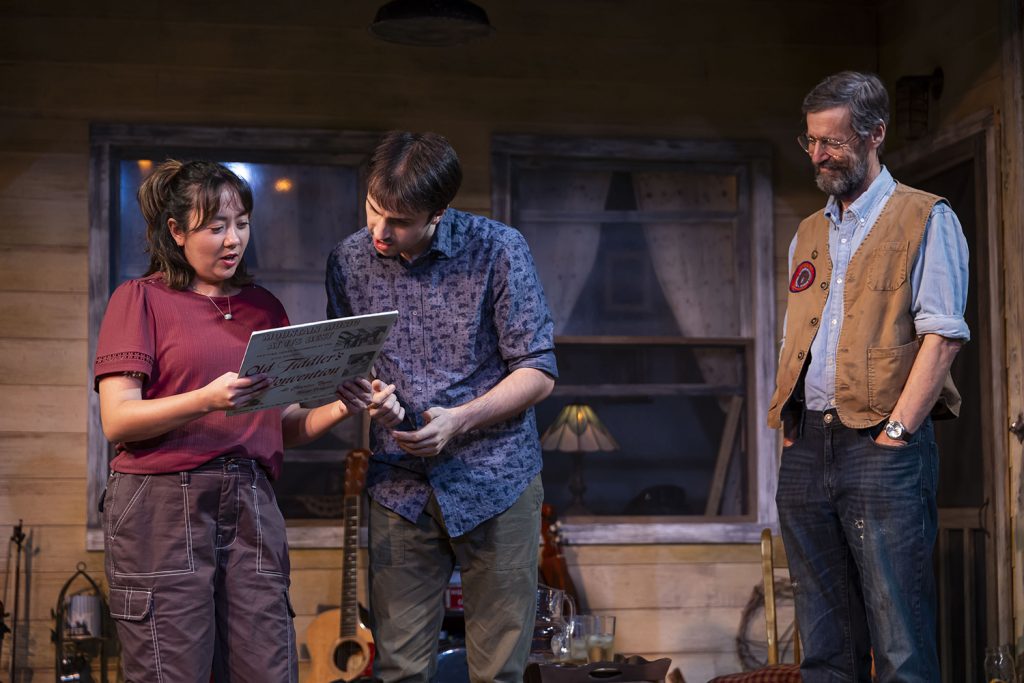
Pictured Above: Tora Nogami Alexander, Morgan Morse, and David M. Lutken. Photo Credit: Ben Hider.
What followed was a deeply collaborative process shaped by the realities of the moment.
“We started out on Zoom,” Morse said. “We’d just get together and throw ideas around. If anyone had a thought, it went into the Google Drive. Scenes were improvised in studios when possible, rewritten, discarded and rebuilt. By the time rehearsals began for the first production in fall 2021, the script was still evolving. We hadn’t even fully put together Act Two yet. That first production was very much a first draft.”
Still, the response suggested something special was taking shape. The Ivoryton premiere earned four Connecticut Critics’ Circle nominations, and the team knew the story wasn’t finished.
“We all felt it had a lot of potential,” Morse said. “Workshops and readings followed, including a festival presentation in New York and a workshop at Merrimack Repertory Theatre. A major turning point came with the Northlight Theatre production outside Chicago. That’s where a lot of things that have now stayed consistent first appeared, including a key musical moment that opens Act Two.”
As the play continued to travel to Weston Theater Company in Vermont, People’s Light in Pennsylvania and beyond, it also evolved in another important way. Morse stepped away from performing in it for a time.
“That was actually a gift,” he said. “I got to sit in the audience and watch someone else play the role I’d written. You always wonder, ‘Does this only work if I’m doing it?’ And seeing it succeed without me was really affirming.”
The show’s New York debut at Urban Stages last fall marked another milestone.
“It kind of fell into our laps,” Morse said. Through a personal connection, Stregack Lutken was introduced to the Urban Stages team and momentum built quickly. Casting Tora Nogami Alexander proved especially meaningful. She’d auditioned before, and as soon as we saw her tape, we were like, ‘Oh my God, we need her in this show someday. When this run came up, we knew we had to nail her down.”
At its core, The Porch on Windy Hill is a play with music, though not a traditional musical. All the characters are musicians, and they play music together within the plot.
Set in 2021, it follows a young couple (Beck and Mira) traveling from Brooklyn through the South, attending folk music jams for academic research. Morse plays Beck, which he describes as “a bundle of energy. A golden retriever boyfriend.”
“Everything about him is driven by passion: his nerdiness about music, his love for Mira even his anger and that passion pushes the story forward,” he said. “One stop in North Carolina changes everything. They run into this older guy (Lutken) leading the jam and it turns out he’s Mira’s white grandfather, who she hasn’t seen in almost 20 years. Then the rest of the play takes place on his porch—three people playing music and slowly disentangling a complicated family history.”
The themes that inspired the writers during the pandemic—anti-Asian racism, silence and the cost of inaction—remain present, if newly resonant.
“This is a show about the potential consequences of not speaking up,” Morse said.
To extend that ethos beyond the stage, the company has paired performances with real-world action, including benefit recordings and post-show “hootenannies” where audiences are invited to bring instruments and play together.
“It reminds people of the simple joy of gathering,” Morse said. “I’d hope people walk out with a feeling of hope, but a hope that’s hard-earned. Music is the key. It can be a bridge. It opens us up in a way that words can’t, and then maybe it allows us to have the words.”
For tickets or more information, visit www.urbanstages.org/porch.

