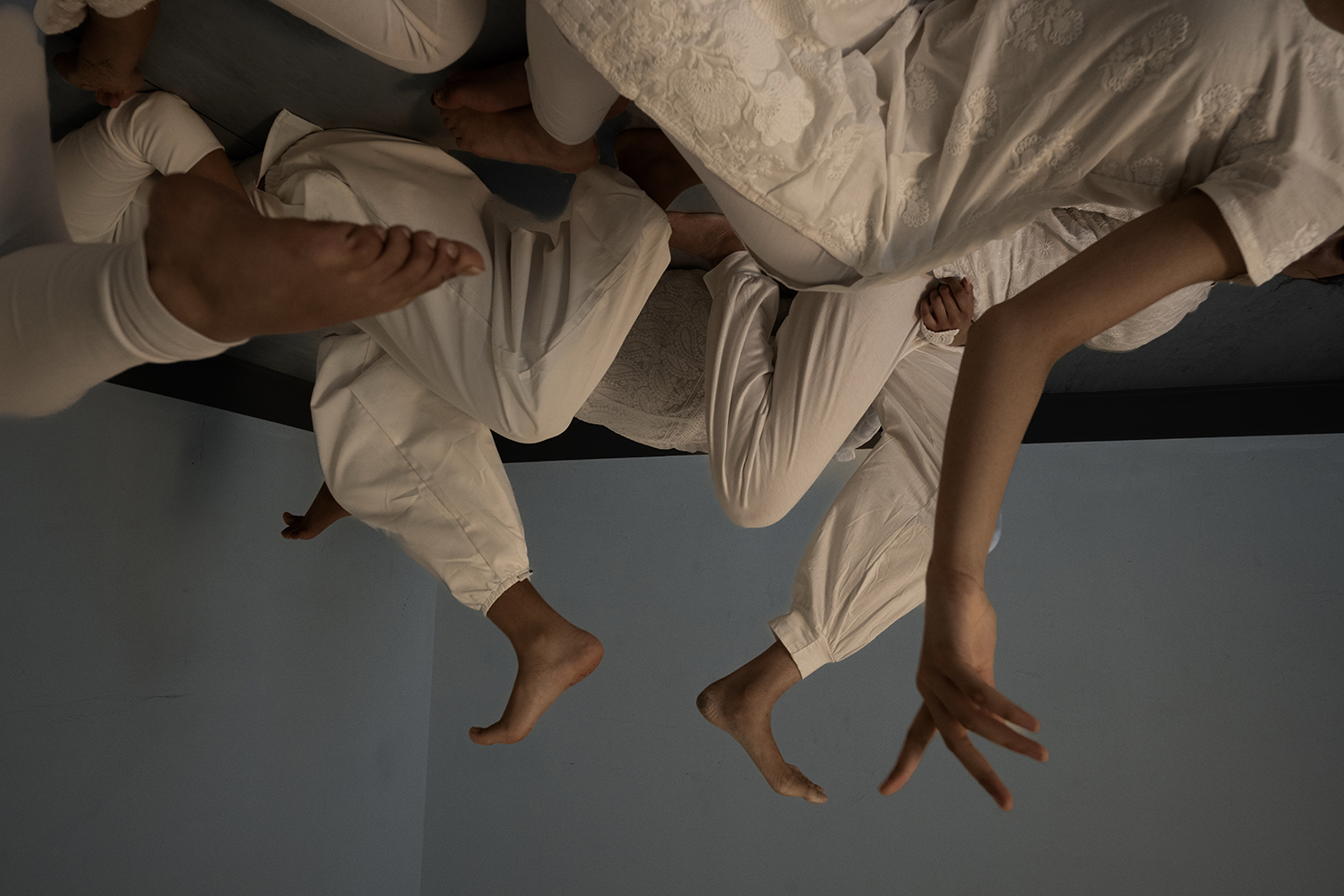
Pictured Above: Dancers of The Hourglass – Concept, Choreography, Costumes & Soundscape: Mesma Belsaré Commissioned by Kulture Kool, New Jersey. Photo Credit: Abhijeet Nakhwa
Indian Classical Dance Reimagined: The Hourglass Previews in Montclair Ahead of European Tour
By: Jasmine Spero
In her latest article, writer Jasmine Spero explores Mesma Belsaré’s The Hourglass, a Kulture Kool commission previewing in Montclair, where the dancers’ classical Bharatanātyam and Kathak training serves as the foundation for a contemporary movement language shaped by myth, ritual, and sustained tension.
The invited preview comes before the five dancers, classically trained in Bharatanātyam and Kathak, embark on a European tour in July with stops in Athens, Italy, London and Glasgow.
By bringing these traditional forms to a broader public platform, Kulture Kool founder and director Archana Athalye hopes to challenge how certain art forms are categorized.
“It should not be in a corner somewhere and just deemed too ethnic to come into the mainstream,” Athalye said. “The whole effort is to bring more and more cultural arts into mainstream platforms.”
Belsaré said she pushed the dancers to move beyond their classical training into a more instinctive space, creating a “productive resistance” between their institutional and pre-institutional selves.
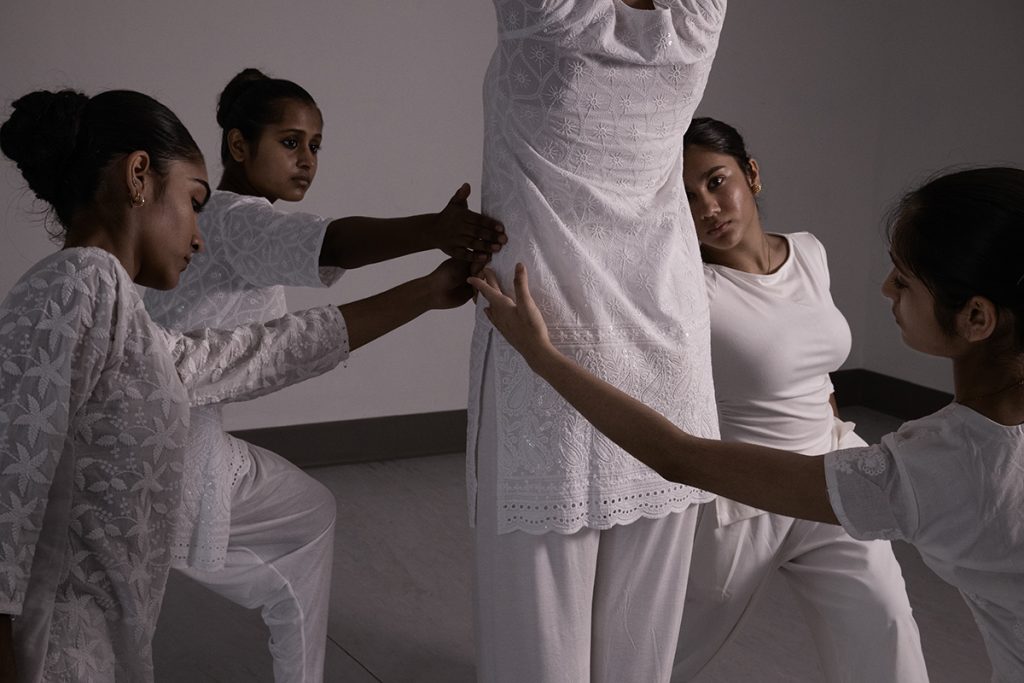
Pictured Above: Dancers of The Hourglass – Concept, Choreography, Costumes & Soundscape: Mesma Belsaré Commissioned by Kulture Kool, New Jersey. Photo Credit: Abhijeet Nakhwa
“In that zone of tension, of resistance, I find the technology for the choreography to take place,” Belsaré said. “So that becomes the point of constriction, just like that of the hourglass.”
Shuchi Sutaria, the youngest dancer, said her classical training taught her to convey emotion through hand gestures and movement.
“But through this experience, I’ve been able to live in that emotion itself instead of just trying to convey it,” Sutaria said.
Her internal shift mirrors the framework of The Hourglass, which draws on the Puranic myth of Samudra Manthana, the cosmic churning of the ocean by opposing forces. Rather than offering a literal retelling, Belsaré uses the archetypal story as an abstract blueprint for the dancers’ movement and emotional states.
“Our modern minds want to find logic in it, but the piece is meant to expose the limits of that way of thinking by pointing toward something much greater than what we can comprehend logically,” Belsaré said. “There is no literal conflict and resolution in this piece.”
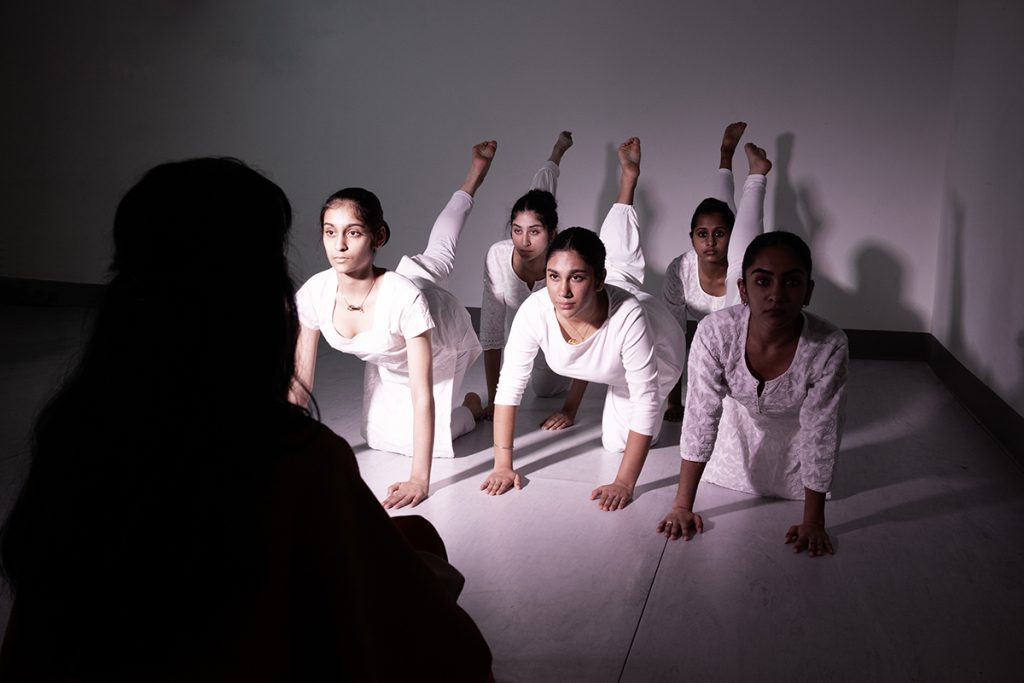
Pictured Above: Dancers of The Hourglass – Concept, Choreography, Costumes & Soundscape: Mesma Belsaré Commissioned by Kulture Kool, New Jersey. Photo Credit: Abhijeet Nakhwa
With the performers rooted in this non-linear space, the production shifts its focus toward transferring that raw energy directly to the audience.
“What I’m expecting is the audience is to experience that [tension] in their own bodies, and that’s what makes it a ritual,” Belsaré said.
 Independent Arts News Reporting