Independent Arts News Reporting
 Princeton University Art Museum Announces Takeda Hideo’s Genpei: Defying Authority
Reported on Thursday, August 20, 2026
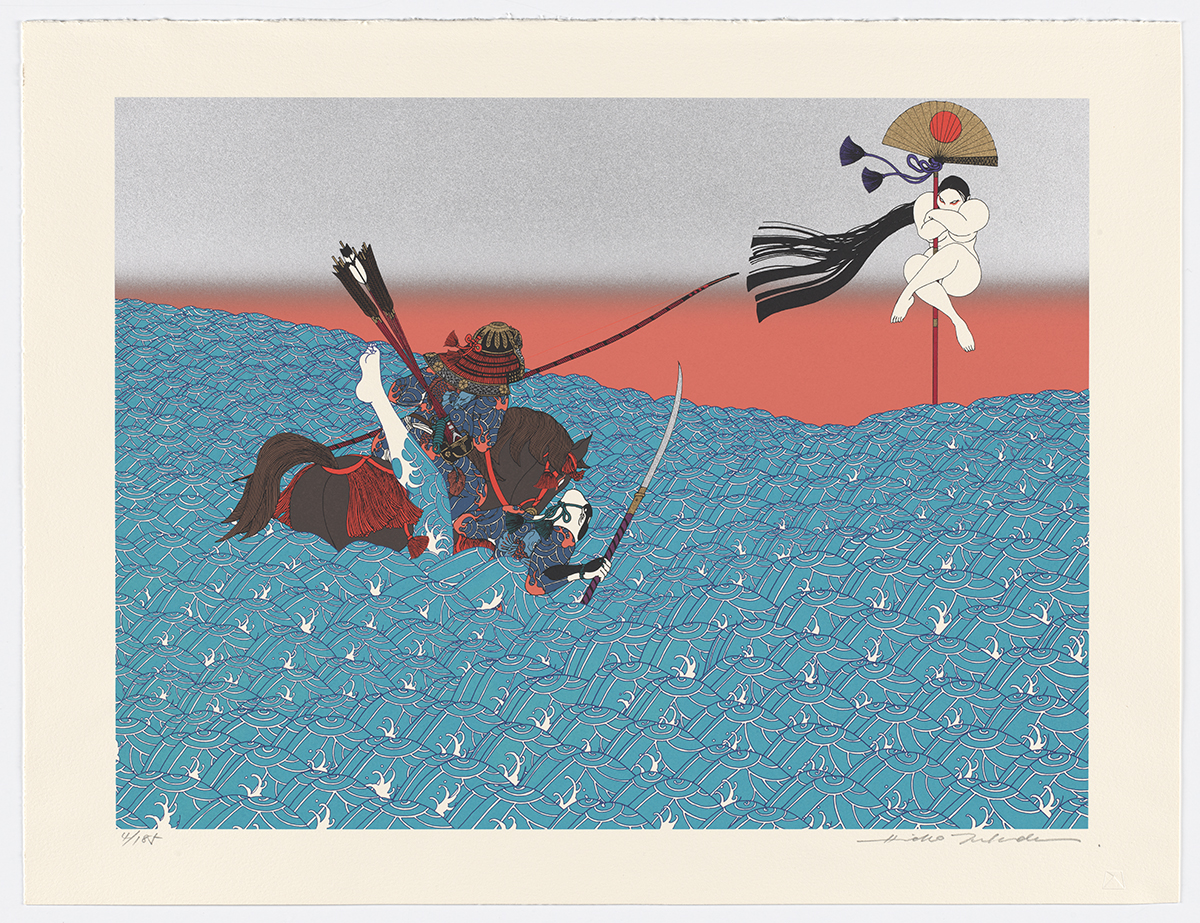
Pictured Above: Takeda Hideo 武田 秀雄, The Mark of the Fan (Ōgi no mato 扇の的 ), from the series Genpei 源平 , 1985. Screenprint. Princeton University Art Museum. Museum purchase, Mary Trumbull Adams Art Fund © Takeda Hideo. Photo Credit: Joseph Hu.
NEWRSOOM POST: PRINCETON, NEW JERSEY
Exhibition presents 22 screenprints that reinterpret a medieval Japanese epic for modern times
Princeton, NJ – The Princeton University Art Museum presents Takeda Hideo’s Genpei: Defying Authority, an exhibition of 22 screenprints by the Japanese artist Takeda Hideo (b. 1948), on view from August 30, 2026, to January 3, 2027. The exhibition focuses on Takeda’s most celebrated series—Genpei, which was produced between 1985 and 1999. The exhibition offers contemporary audiences a striking reinterpretation of The Tale of the Heike, the medieval epic recounting the twelfth-century Genpei War between the Minamoto and Taira clans. The Tale of the Heike’s romanticization of warfare and portrayal of masculinity would endure in Japan’s national imagination for centuries.
The exhibition brings together all twenty-two prints from this series to the United States for the first time, alongside a focused selection of additional works and contextual materials. Through this presentation, the exhibition repositions Takeda’s work within the cultural, political, and artistic landscape of late twentieth-century Japan and challenges traditional ideas of representation, of the samurai, and of ideals of heroic masculinity.
Rather than illustrating The Tale of the Heike in a conventional manner, Takeda’s Genpei series offers a more humorous and often cynical reinterpretation of the narrative. The prints depict scenes from the war with bold graphic intensity, incorporating stylized patterning, vivid color contrasts—including the symbolic red and white associated with the rival clans—and exaggerated, anachronistically tattooed figures that disrupt expectations based on how the Genpei War is typically portrayed.
“Takeda’s work is visually arresting, provocative, and deeply engaged with the social and political currents of our time, offering a powerful lens through which to reconsider both history and its representation,” said James Steward, Nancy A. Nasher–David J. Haemisegger, Class of 1976, Director of the Princeton University Art Museum. “By bringing this series to Princeton, we invite visitors to consider the power of art to question cultural narratives.”
“Takeda Hideo’s Genpei is striking because it is a sharp, sometimes irreverent critique that challenges long-standing assumptions about the authority of Japanese history as it is usually presented,” said Kit Brooks, Curator of Asian Art, Princeton University Art Museum. “Takeda recasts this romanticized war epic as something far more unstable and human, exposing the absurdity, violence, and self-absorbed motives at its core while reflecting the social and political currents of late twentieth-century Japan.”
The artist disrupts the typical portrayal of episodes from the Genpei War both through the stories he selected for his series and by how he treated the narratives being pictured. For example, in works such as The Mark of the Fan, Takeda transforms a celebrated moment of martial skill into a visually unsettling composition in which a lone warrior advances through a sea of submerged, tattooed bodies. Elsewhere, figures from the epic are rendered in a satirical fashion: the legendary general Yoshitsune, for example, is depicted with grotesque and irreverent imagery that undermines the idealized masculinity of the samurai class. In another scene, the warlord Taira no Kiyomori appears tormented by demonic forces in a feverish vision of guilt and excess. Takeda’s use of full-body tattoo motifs—an anachronistic element influenced by associations with Japan’s modern criminal underworld—recasts the Genpei War as a conflict between rival gangs rather than a noble clash of warrior elites. Through these choices, the artist exposes the constructed nature of historical narratives and critiques the romanticization of violence and power.
The exhibition also situates Takeda’s practice within broader artistic and political developments in postwar Japan. Trained at Tama Art University in the early 1970s during a period shaped by student protest movements and social upheaval, Takeda developed a visual language rooted in satire, economy of form, and graphic immediacy. His work as a political cartoonist, as well as his engagement with poster design, informs the bold formal clarity and subversive humor of the Genpei series.
Takeda Hideo’s Genpei: Defying Authority is curated by Kit Brooks, curator of Asian art at the Princeton University Art Museum. An accompanying book—the first to be published on the artist in English in several decades—features a major new essay on the artist written by Brooks, an interview with the artist, and an essay by Elizabeth Oyler, a specialist in The Tale of the Heike and noh performance, examining the reinterpretations of the epic from its earliest incarnations into the present.
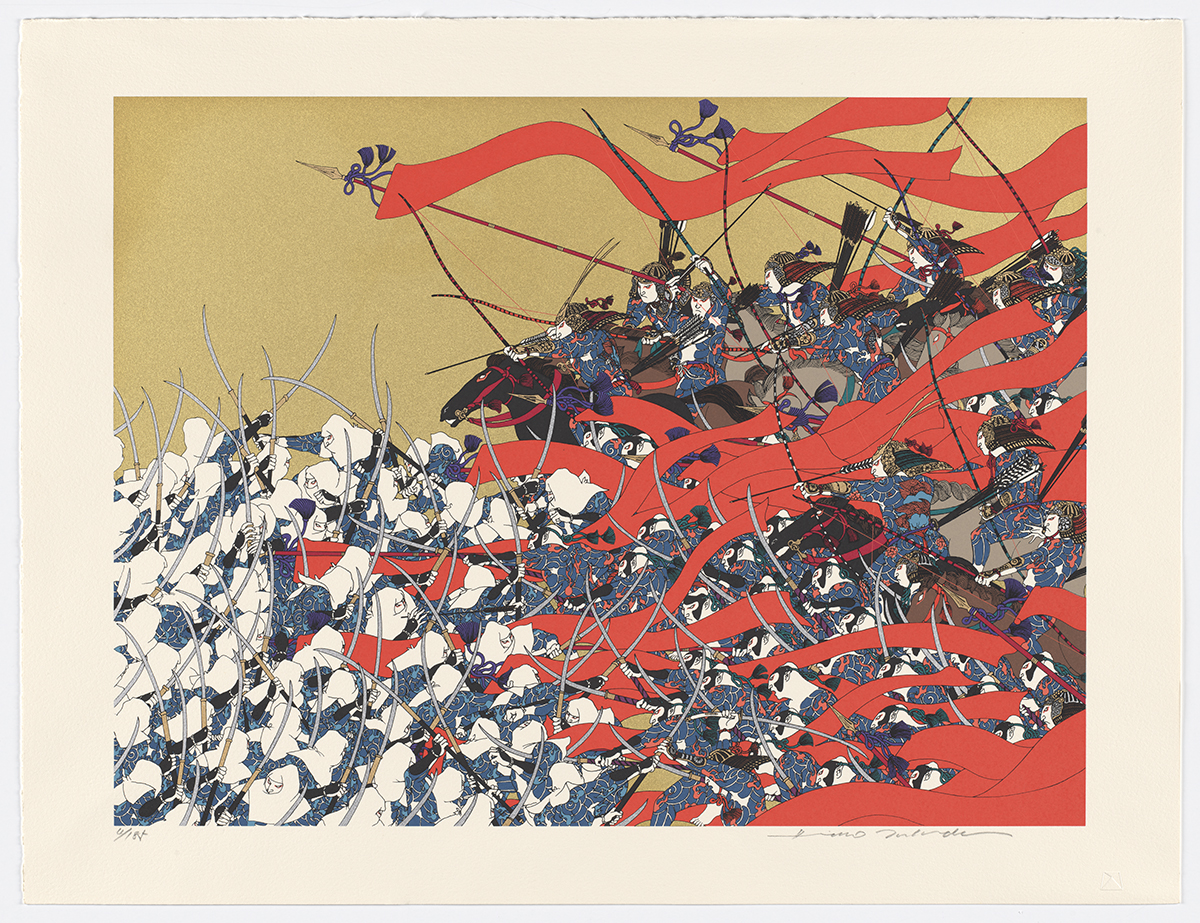
Pictured Above: Takeda Hideo 武田 秀雄, Invasion of the Southern Capital (Nanto shinkō南都侵攻 ), from the series Genpei 源平, 1985. Screenprint. Princeton University Art Museum. Museum purchase, Mary Trumbull Adams Art Fund © Takeda Hideo. Photo Credit: Joseph Hu.
Exhibition support
The exhibition project Takeda Hideo’s Genpei: Defying Authority is made possible in part by the Japan Foundation; the John B. Elliot, Class of 1951, Fund for Asian Art; the Melanie and John Clarke Exhibition Fund; the Morley and Jean Melden Education Fund for Prints and Drawings; Princeton University’s P.Y. and Kinmay W. Tang Center for East Asian Art; the Robert W. Bagley Fund for Asian Art; the Virginia and Bagley Wright, Class of 1946, Fund for Modern and Contemporary Art; and the many generous contributors to the Director’s Exhibition Fund. The accompanying publication is supported by the Andrew W. Mellon Foundation Fund and the Barr Ferree Foundation Fund for Publications, Department of Art & Archaeology, Princeton University.
About the Princeton University Art Museum
With a collecting history that extends back to 1755, the Princeton University Art Museum is one of the leading university art museums in the country, featuring collections that have grown to include more than 117,000 works of art ranging from ancient to contemporary art and spanning the globe. Committed to advancing Princeton’s teaching and research missions, the Art Museum also serves as an entry point to the University for visitors from around the world.
The bold and welcoming new Princeton University Art Museum is open daily at the heart of Princeton’s campus. Admission is free to all. Mosaic, the Museum’s new restaurant, is located inside the new Museum and is open Thursday through Monday.
Please visit the Museum’s website for digital access to the collections, a diverse portfolio of programs, and details on visiting. The main Museum Store, located within the new Museum, and the Museum Store in Palmer Square, located at 56 Nassau Street in downtown Princeton, are open daily, or shop online at www.princetonmuseumstore.org.