 Independent Arts News Reporting
Pictured Above: Violinist, Randall Goosby. Photo Credit: Jeremy Mitchell.
The New Jersey Symphony Welcomes the Return of Violinist Randall Goosby
By: Lori Goldstein
At just 29, violinist Randall Goosby has already become one of the most respected and inspired figures in today’s classical music world. His return to the New Jersey Symphony this season marks not just a homecoming, but a beautifully unfolding new chapter. In this feature, Lori Goldstein traces Randall’s development from Suzuki classes to lessons with the great masters who have shaped his musical soul. What emerges is a portrait of an artist who leads with humility, heart, and deep curiosity.
Randall Goosby, the 29-year-old concert violinist who, at age 13, was the youngest ever to win the Sphinx Competition, last performed with the New Jersey Symphony in 2023. Back by popular demand, he returns to the Symphony in a 4-concert performance of the beloved Barber Violin Concerto on January 8-11, 2026.
In a whirlwind year of jetting back and forth across the country for solo and chamber music appearances, Randall has firmly established himself as a violinist whose musical maturity belies his relative youth. That is perhaps due to the way he was brought up and the way he was taught. When he was seven, his Korean mother, Jiji Goosby, shepherded his music education, attending his Suzuki violin lessons and taking notes. She and his father, Ralph Goosby, never used the “p-word”—prodigy.
“A sense of modesty and humbleness was something that was very important to them, and still is to me,” says Randall. “Kids who have a lot of success and a great deal of talent, and who are lucky enough to have that perfect storm of a wonderful teacher, a supportive family, and opportunities to showcase their talent…sometimes are in a position of great risk. Because you’ve accomplished so much, and you’ve refined your work so hard by the time you’re 15 or 16, you sometimes emotionally or mentally burn out. I didn’t have the opportunity to do that, thankfully, because my parents really stressed the importance of a sense of balance.”
“On one hand I had my mom holding the kitchen timer next to me, waiting for it to ding for me to get to my next hour of practice. And I had my dad in the next room saying, ‘It’s Saturday afternoon, let him go outside, his friends are at the door, they want to play basketball.’” Even in the car on the way to lessons, the Goosbys’ different parenting styles were audible. His mother would play violin concertos; his father reveled in Motown tunes.
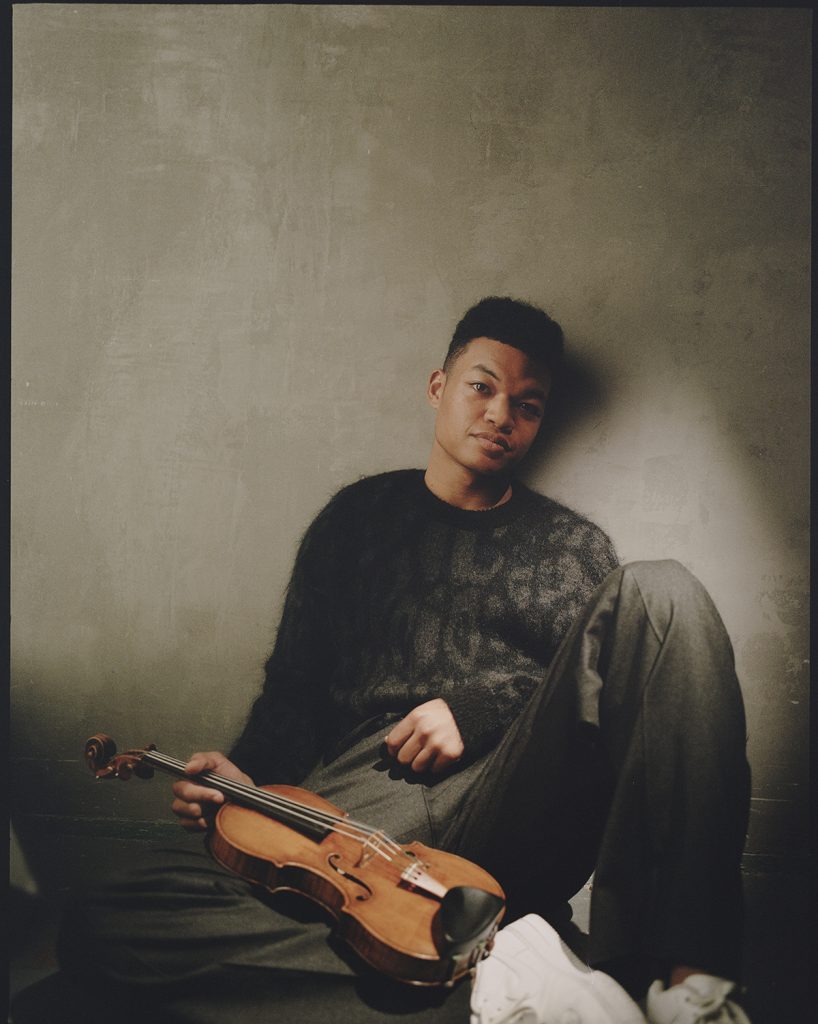
Pictured Above: Violinist, Randall Goosby. Photo Credit: Oolie Ali
The teachers who had the greatest impact on Randall when he studied at The Juilliard School were Itzhak Perlman and Catherine Cho, who worked in tandem with Mr. Perlman. When I ask Randall if he can share any stories about his experience with the Buddha of the violin, he smiles, thinking back to when he was 14, at Shelter Island, NY—the summer of 2011, his first time at the Perlman Music Program.
“I was terrified, because I knew that this was the domain of the great Itzhak Perlman. Not to mention I was about to meet 40 other kids and I didn’t know how the level of my playing stacked up.” He was waiting in the cafeteria lunch line, “and the gentleman in front of me is none other than Mr. Perlman. So I’m standing there, just quaking in my boots. I haven’t said anything to him, I don’t know what to say. I’m incredibly nervous.”
“That day, we happened to be having chicken nuggets for lunch. Of course, there’s a serving spoon or tongs for everyone to serve themselves. Mr. Perlman looked at it for a second and just goes ‘agh,’ takes this huge bear-claw of a hand that he has, reaches into [the pan] and slaps the nuggets down onto his plate. For me, that was a moment to just exhale and be like, okay, we’re actually not that different. He loves his chicken nuggets as much as I do, and if you don’t want to use the tongs, why do it?”
“That’s part of why he is such a beloved personality in the classical music world,” says Randall. “He’s so unbelievably down-to-earth and personable and relatable, in ways that you would never expect from a violin icon. He’s kind of a goofball. He loves to tell jokes, he loves to laugh.”
Another story that Randall likes to tell is about his very first lesson with Itzhak Perlman a few days later at the camp. He played for him Wieniawski’s 2nd Violin Concerto, which is “devilishly difficult, with a lot of technical hurdles to navigate.” Randall had listened to Itzhak’s recording of the concerto, and had many practical questions about it.
“Let me stop you before I answer any of your questions,” said Itzhak. “I have a question for you. What is it this music makes you feel? What is the emotion? The impact? What’s the message behind this music?”
Randall offhandedly responded, “I don’t know, it makes me nervous.” He said he hadn’t thought much about the emotional impact of something as technical as the Wieniawski.
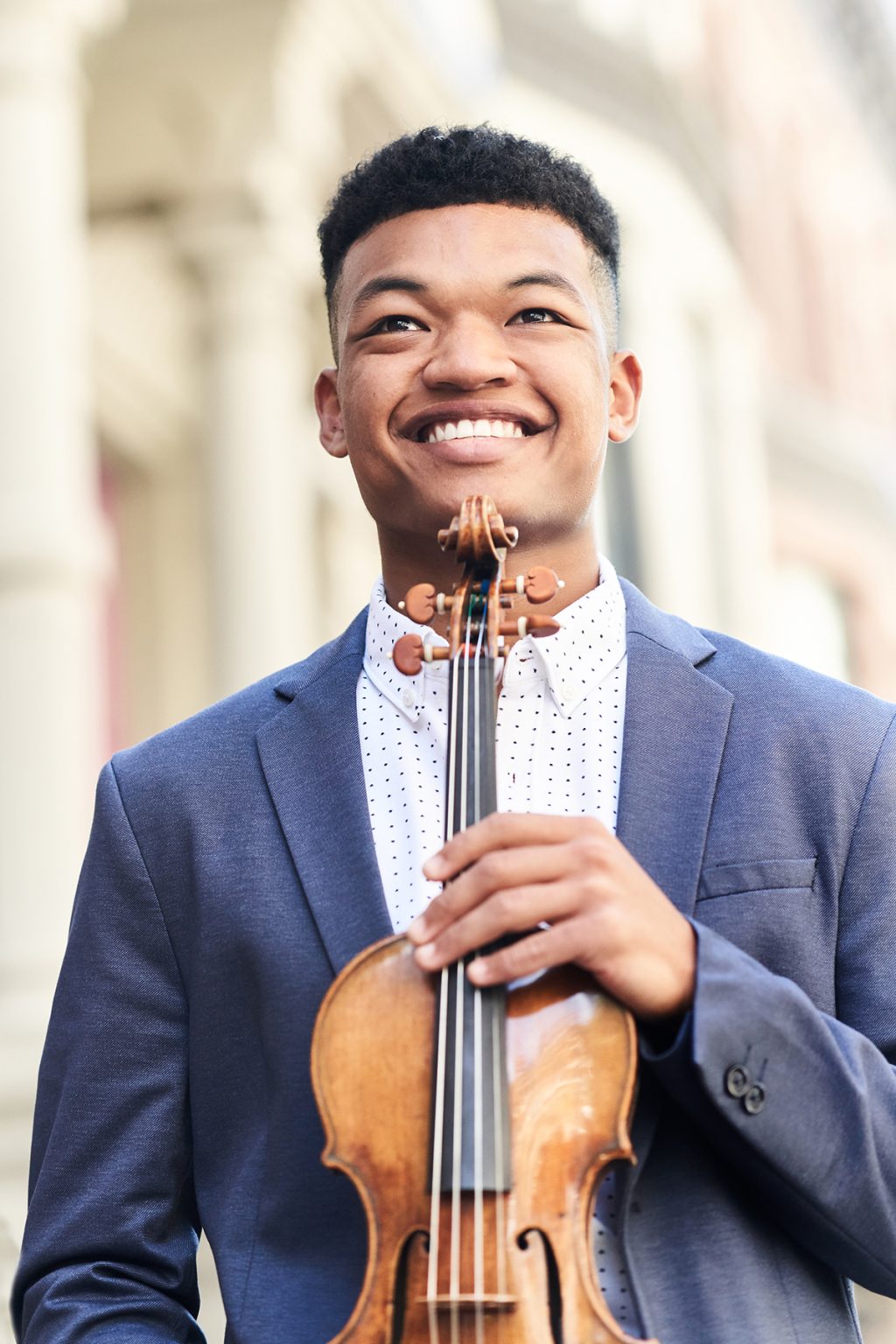
Pictured Above: Violinist, Randall Goosby. Photo Credit: Kaupo Kikkas.
“Why don’t you think about it, come back to me, and then we can talk about your questions. We can talk about the technique,” said Itzhak. “Because until you have some kind of an idea of what this story is that you’re trying to spin with this music, the technique is meaningless.”
“Telling the story, we have to find that first,” says Randall. “We have to treat the music as the entry point…Mr. Perlman approaches music from a place of curiosity. What is it that you want to do with this music?”
I ask Randall a similar question when we discuss the Barber Violin Concerto: how does it speak to him? “One of the emotional characteristics that I really enjoy diving into and playing around with is this sense of melancholy or nostalgia, or a bit of a teary-eyed smile. It’s not all butterflies in the stomach. There’s quite a bit of athleticism, and some whimsy involved.” Randall imagines a visual landscape, “in Europe [where the Philadelphia composer was when he wrote much of it], a remote alpine setting. The first movement feels airborne to me. It just feels like we’re flying through this very beautiful, panoramic landscape where we find lots of different elements—water, wind, greenery, and rolling plains.”
To Randall, the mark of a great concerto is a great second movement. “That’s what cements this concerto in the upper echelon of violin concertos.” Barber’s second movement is “absolutely stunning, and I guess the only other concerto I can think of that opens quite like this second movement does would be the Brahms Violin Concerto, which is probably my all-time favorite. Barber actually gives the opening solo oboe melody, which is absolutely beautiful, to the violin, whereas Brahms wasn’t so generous.”
“The texture that Barber creates with the strings reminds me a little bit of the Barber Adagio. You have this soaring, kind of yearning, oboe line over the top, which, honestly for me, sometimes it can be difficult to come in. After hearing this beautiful oboe melody, the second movement is a lot more dark and misty. It feels like the calm after a storm, where something maybe quite tragic has happened. And yet there’s still beauty that can emerge. When the violin finally gets the theme, it’s way up on the G string, which is probably the most satisfying register.” Randall finds the third movement “quite strange. Suddenly you’re plopped down in the middle of the American Industrial Revolution. It’s a moto perpetuo—it literally doesn’t stop. You’ve got moving parts all over the place, people running around, hustling and bustling and working. There are 10 to 15 second-long passes for the violin, but even in those places, the orchestra is moving. And especially when you get to the coda at the very end, it feels like a race to the finish line. With all the passion and fire that exists in an understated way in the first two movements, that all bubbles right to the surface in the third movement, and ends with an abrupt, but definitive bang to close out the piece.”
With the New Jersey Symphony concerts giving Randall an auspicious start to the New Year, he is also eager to join the six-concert tour with the Sphinx Virtuosi in February and March. The Sphinx Virtuosi is a self-conducted chamber orchestra and the flagship performing ensemble of the Sphinx Organization, the nation’s leading nonprofit dedicated to transforming the arts. “This is a very special opportunity for me for a couple of reasons, the first of which is that after all of these years of having been involved in Sphinx and being a member of the Sphinx familia, as they call it, I’ve never been able to take part in the tour.” Randall has performed in one or two concerts of the tour over the years, but this will be the first time he’ll be able to play for the tour’s entirety.
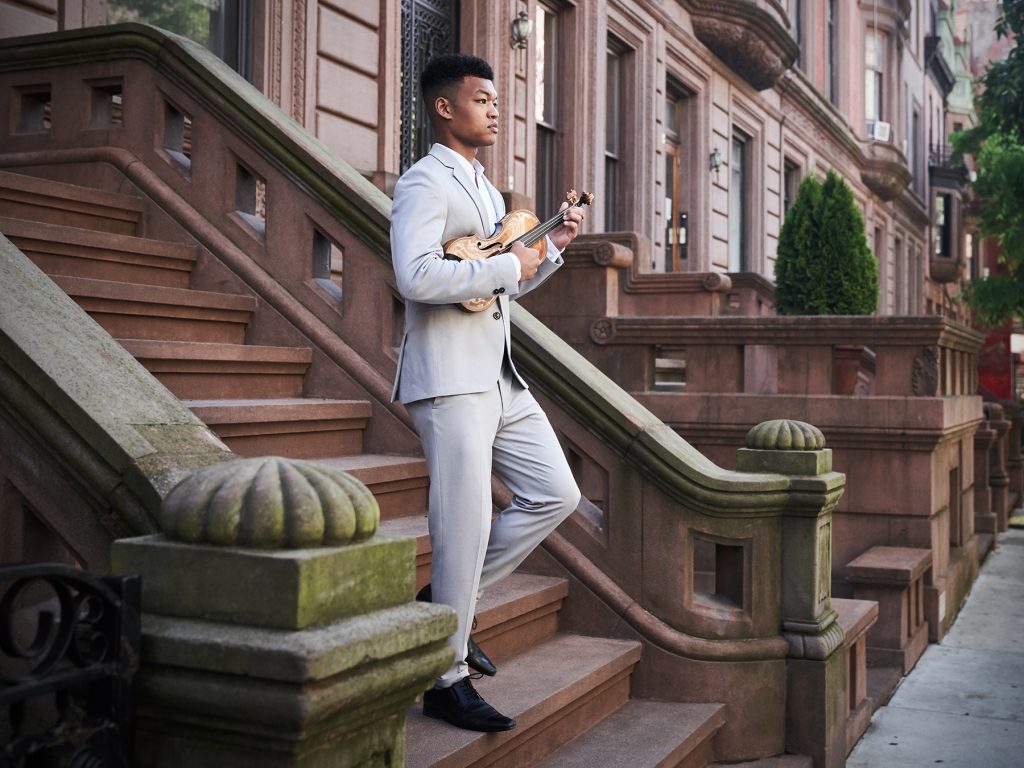
Pictured Above: Violinist, Randall Goosby. Photo Credit: Kaupo Kikkas.
Randall is particularly excited that he’ll solo with the Sphinx Virtuosi in a performance of his arrangement of William Grant Still’s Suite for Violin and String Orchestra. Still originally composed it for violin and piano. “Sphinx was one of the first places, in addition to the Perlman Music Program, where I felt a real sense of community. So to be able to dive right back into that community, to play not only the solo part for my arrangement, but also the rest of the program with the ensemble is something I’m really looking forward to.” Feeling a sense of belonging in those two communities was the impetus for Randall’s certainty at age 14 that he wanted to become a concert violinist.
William Grant Still is just one of a number of underrepresented composers of color past and present whom Randall has championed in live performances and recordings. He has recorded Florence Price’s Violin Concerto along with her Adoration and Fantasies No. 1 and 2 with Yannick Nezet-Séguin and the Philadelphia Orchestra. His 2024 Roots Deluxe Edition album includes Carlos Simon’s Hold Fast to Dreams, Xavier Dubois Foley’s Shelter Island, and Coleridge-Taylor Perkinson’s Blue/s Forms and Deep River. He has recorded selections from Porgy and Bess as well as the Still Suite with pianist Zhu Wang on the original Roots album. Randall performs as first violinist with the New York City-based Renaissance Quartet, and in the fall of 2026, he’ll begin a teaching post at the Juilliard Pre-College program which he himself attended.
Whenever Randall takes a flight to his next concert, two items always travel with him: the 1708 Stradivarius on loan from the Samsung Foundation of Culture in Korea, and his golf clubs. Golf was a sport he started playing when his mom did, about seven or eight years ago. “I made fun of her for it, [saying] ‘You got me into classical violin, you couldn’t pick a cooler hobby?’ She suggested I try it. My first time out I worked up a good sweat, and it was 45 minutes before I hit one good shot. That thing happened where your pupils dilate, and you just go, wow, that felt really good. So ever since then, I’ve been addicted to it. It allows me to be a little bit competitive, and also for that competitiveness to not really matter, the way [a concert] performance does.”
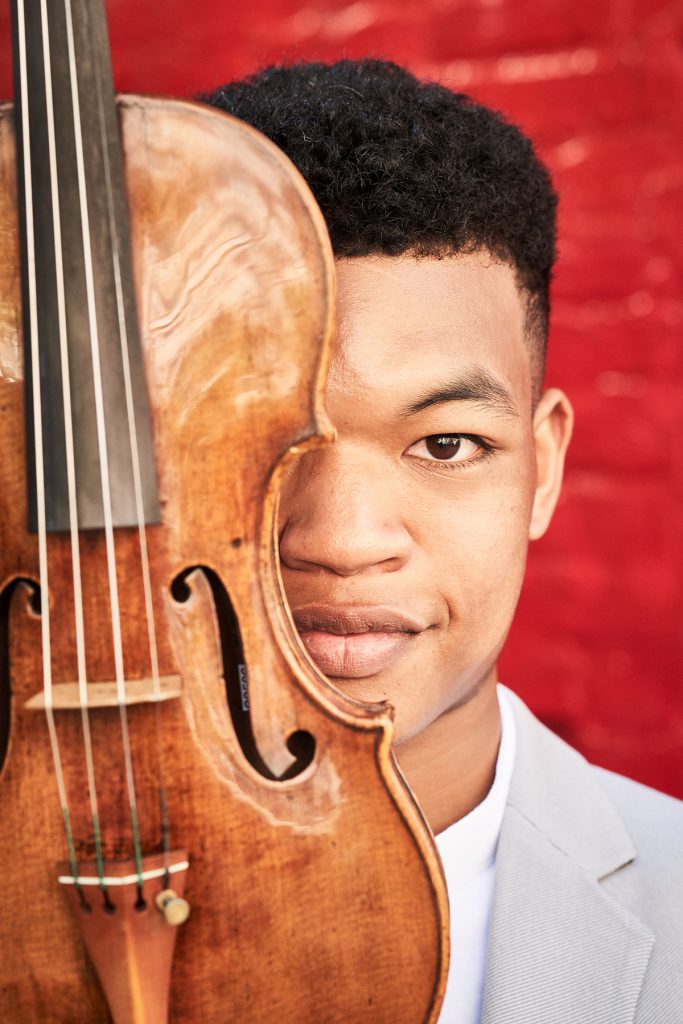
Pictured Above: Violinist, Randall Goosby. Photo Credit: Kaupo Kikkas.
Randall Goosby Returns:
Thurs., Jan. 8 State Theatre New Jersey in New Brunswick
Fri., Jan. 9 Richardson Auditorium in Princeton
Sat., Jan. 10 New Jersey Performing Arts Center in Newark
Sun., Jan. 11 Mayo Performing Arts Center in Morristown
Tickets available at njsymphony.org.