Independent Arts News Reporting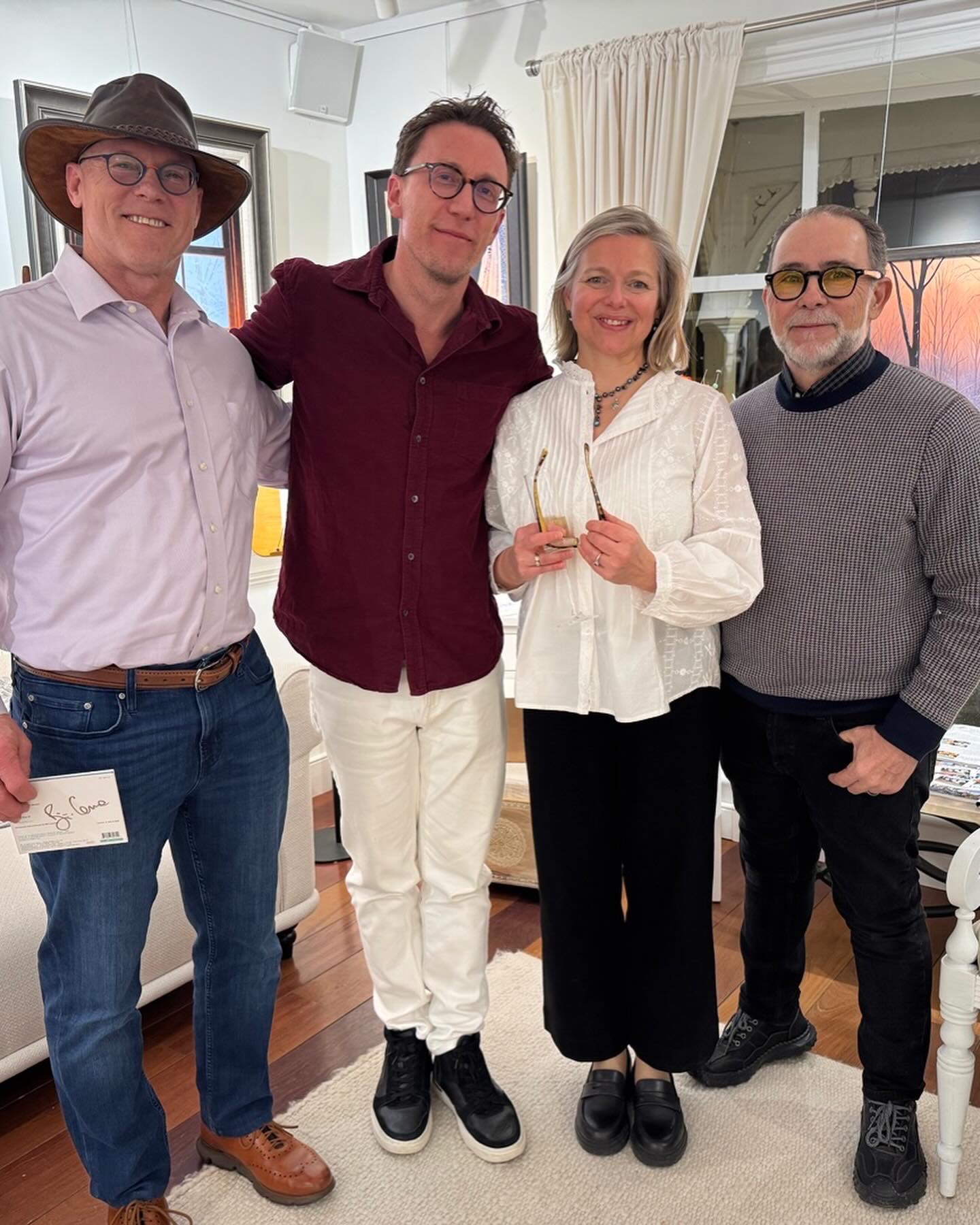
Pictured Above: Heidi Breyer and guests pictured inside the Dancing Elephant on Mechanics Street, New Hope, PA. Photo Credit: Contributed.
Where Art and Music Meet: Inside New Hope’s Dancing Elephant
By: Chrysa Smith
At The Dancing Elephant in New Hope, visual art and music come together in an intimate setting. Founded by composer and pianist Heidi Breyer, the gallery pairs the striking realism of artist Alexander Volkov with Breyer’s compositions and live performances—creating a space where art is both seen and heard.
The story behind the gallery front is a moving one. It’s born out of the emotional outpouring triggered by our times and of our landscapes. New Hope’s Dancing Elephant Gallery and Listening Space is an interesting and most unique and intimate art gallery/musical performance venue. If you haven’t been there, you should go. Because the art that graces its walls is palpable; the music that flows from the grand piano and guest performers is quite accomplished. All housed in a tiny brick building on Mechanic Street. The gallery is the brainchild of composer/pianist Heidi Breyer and her partner and realism artist, Alexander Volkov. It’s only been open about a year, but the little space has a big heart, with events planned out for the future that involve the mingling of music and art—a match made in heaven. You might wonder why two creatives haven’t brought such a place to fruition before, but as of now, Heidi says she doesn’t know of any other such place.
First the art. It’s primarily the work of Alexander Volkov. Born in Russia, Al began his painting career in high school. As he advanced, he would paint the city landscapes—tops of buildings, skylines of Leningrad. According to Heidi, “At 14, Al was in a car accident and broke his leg. Someone gave him a box of paints to stave off the boredom, and he painted a copy of William Turner’s, The Glorious Temeraire (The fighting Temeraire) and discovered he had a gift.” Leaving Russia in 1989, he settled in Hunterdon County, New Jersey, where he became influenced by the stark contrast of rural life there and throughout Bucks County. His work, whether landscape or still life, is all about light—the juxtaposition of light and dark, shadows cast in the sky, on buildings, in nature. He says, “There is no greater mystery to me than the conflict of light and darkness. In the way they clash and penetrate each other, there is the source of everything. Whether I paint a landscape, a still-life or a portrait, within it there is always a story of light traveling through darkness.” And according to Heidi, his realism is personal. “The only pieces which are not real places are those with human form in them,” Heidi says. “They are not necessarily people he knows, but emotions evoked from within himself.” One was from a closed New Jersey church interior where he sat for hours, just studying. Others are inspired by what ‘might be.’ Heidi pointed out one painting of the Bucks County Playhouse, titled Strangers in the Night. She says, “It an example of how Al takes reality and adds his artistic license and romantic perspective. His paintings are not about how closely he can match a given subject matter, but rather, the way he perceives it in a different light to the rest of us.” Heidi says he noticed a tree in the forefront of the playhouse and imagined it in the moonlight. I loved it. Also ‘Buddy’—the depiction of autumn leaves swirling in front of a familiar rural scene—an automobile, in this case, an old VW bug, unattended, with sunlight dancing around it as if on a fall day. That’s just of few of the hundreds of paintings, giclee and prints by the artist. Having lived on the west coast, many of his works can be found in galleries out west, such as Park City, Sedona, Houston, Tahoe, San Antonio, and down in Florida. “Al’s work is very collectible. Al has painted about 650-700 pieces over the course of four decades. There are only ever about 40 original paintings on the market at one time because most have sold. All his paintings can be ordered as a Limited Edition Giclee on canvas, or a Limited Edition embellished giclee on canvas—if the edition has not sold out,” she says. His work is unique, growing and learning from some of the greats— Rembrandt, Edward Hopper, Maxfield Parrish and Andrew Wyeth, Nabokov and Steinbeck, Tarkovsky. He says, “If you want to learn, you will always find someone to learn from—be they dead or alive, great or unknown. You will learn from everything you see and hear around you – if you are willing to pay attention. Perhaps, during my formative years, I have made a lot of unnecessary mistakes, but at the same time I have had the enormous advantage of picking my own teachers.”
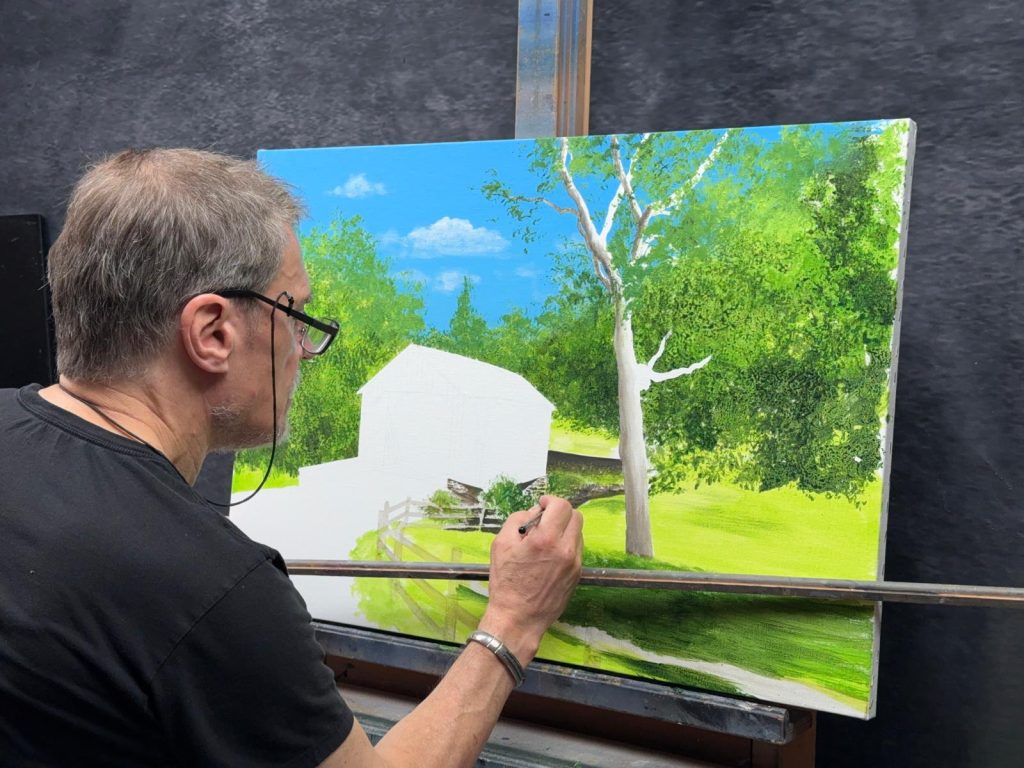
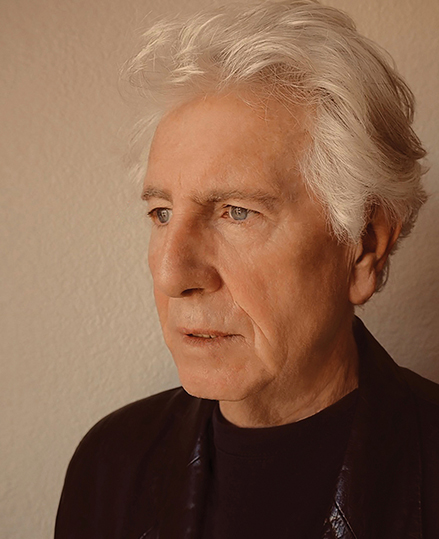
Pictured Above: Artist Alexander Volkov. Photo Credit: Contributed.
Heidi is a classically trained pianist-composer, born in the UK, and set on an arts track at the early age of seven. Her arts education included a rigorous discipline with a dance, drama and music focus, which followed by the study of piano, violin and composition at Trinity College. Heidi’s earlier music was influenced by world events. Her Requiem for the Common Man (Amor Aeternus) addresses the changing possibilities available to the masses. “Over the last quarter of a century, this exuberant spirit and perhaps naïve optimism have evaporated, leaving a void in many souls which has become filled with consumerism, indifference and cynicism,” says the artist. “Everyday people are the unsung heroes upon whose backs our world often now depends. It is for them I have composed this Requiem.”
The Requiem took ten years to write, during which time Heidi wrote and released four other albums of work inspired by Al’s paintings. “The Requiem was recorded during covid,” says Heidi. “Each musician (@15) contributed their part from their home studio/space and Corin Nelsen edited it together in accordance with the score one part at a time.” It was later performed at Stern Auditorium (of Carnegie Hall) with over 60 musicians on stage. Heidi will tell you that since her earliest work, her music style has changed. She says she wants to be the one to bring some joy to the world.

Pictured Above: The Requiem. Photo Credit: Contributed.
Heidi met Al through her kids and soccer. “When Al and I met, it was a tsunami.” Two creatives fell in love, and naturally, their works merged. He asked her to play Chopin for a music video. And then, a gallery seemed like the perfect blending of artistry all housed under one roof. She joked, though I suspect half-heartedly, that she did an eat, pray, love kind of inner and outer journey. “After the passing of my mother, I went to India, came back and decided to open the gallery.” It was something she contemplated for years. “I want to reach people who will appreciate it. My music has evolved beyond working on a piece when looking at a painting. It’s now more holistic.” She also opens the gallery to musical artists and colleagues she admires, in a salon style setting. There is currently one concert each month, from September through June, when they take a summer break and focus on art. She is considering other types of series as well, including an acoustic series and one through the spoken word.
Heidi likens her musical development to emotional development—gaining wisdom over time. “I’ll be writing about the beauty of life. Let’s appreciate, cherish and make beauty that lasts as long as possible.” Heidi’s composed over 100 works, with six albums done with the founder of Windham Hill Records, Grammy-award winning producer, Will Ackerman, and Grammy Winning Producer and Engineer, Corin Nelsen, with whom she did the Requiem. Windham Hill a sort of collective for classical/contemporary crossover music. All of Heidi’s work can be found under her own label: Winterhall Records, her website, www.heidibreyer.com and on other music platforms including Apple Music and Spotify.
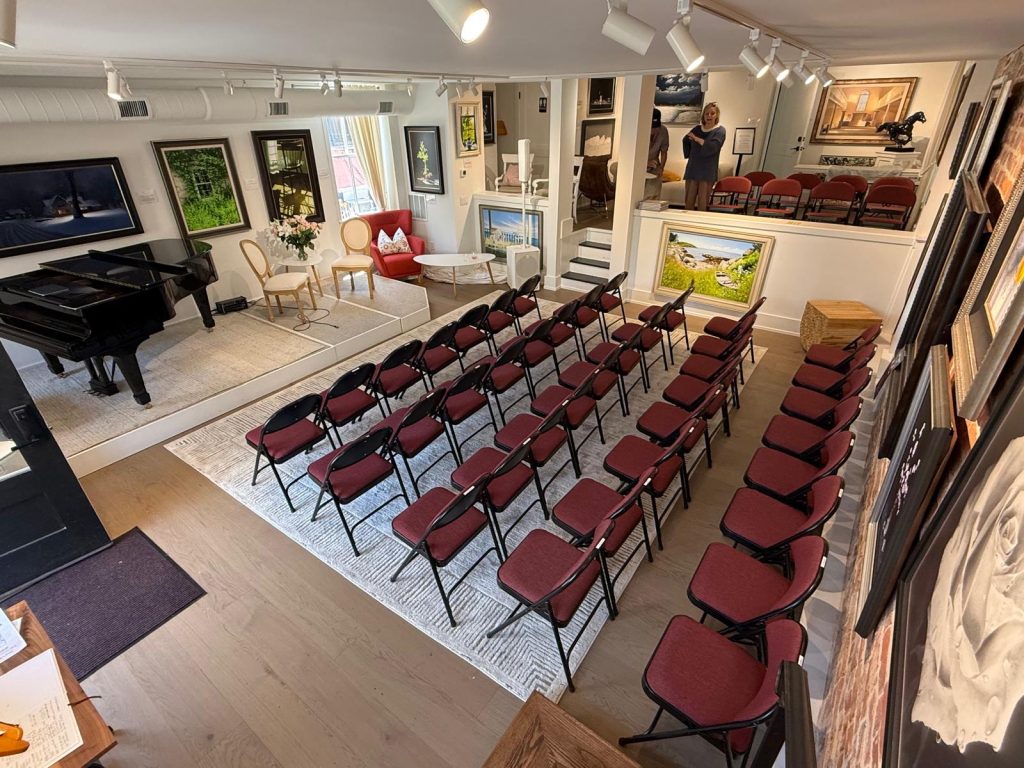
Pictured Above: The gallery and stage at the Dancing Elephant. Photo Credit: Contributed.
And so the question begs, what about the gallery name? If Heidi hadn’t become the seasoned composer/performer she is, if she hadn’t come to the area, settled down, raised children and partner with Al, she would have wanted to work with elephants. “Yes, I love elephants,” she explains. She also loves dance. Merging them apparently seemed like the joyous thing to do. I say dance, elephant, dance.
The Dancing Elephant
17 W. Mechanic Street
New Hope, PA 18938
www.dancingelephantfineart.com
Wed/Thurs/Sun: 12pm – 6pm
Fri/Sat: 12pm – 8pm
The music schedule can be found at: www.dancingelephantfineart.com/event-list.
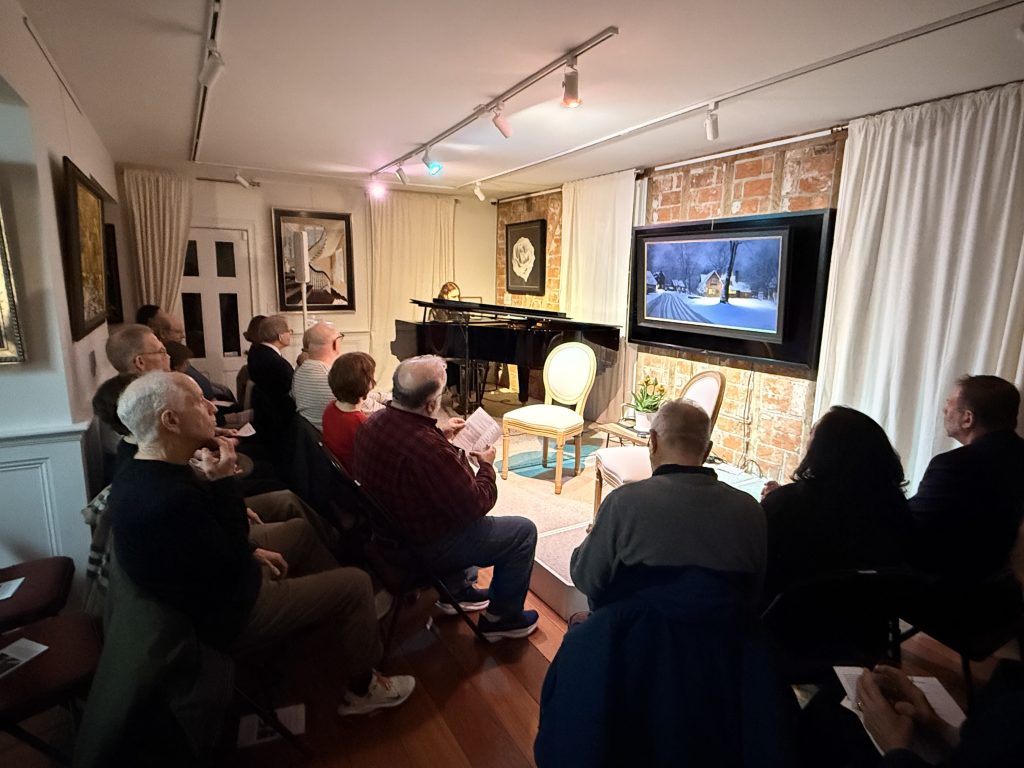
Pictured Above: Guests enjoying a live piano performance at the Dancing Elephant. Photo Credit: Contributed.