Independent Arts News Reporting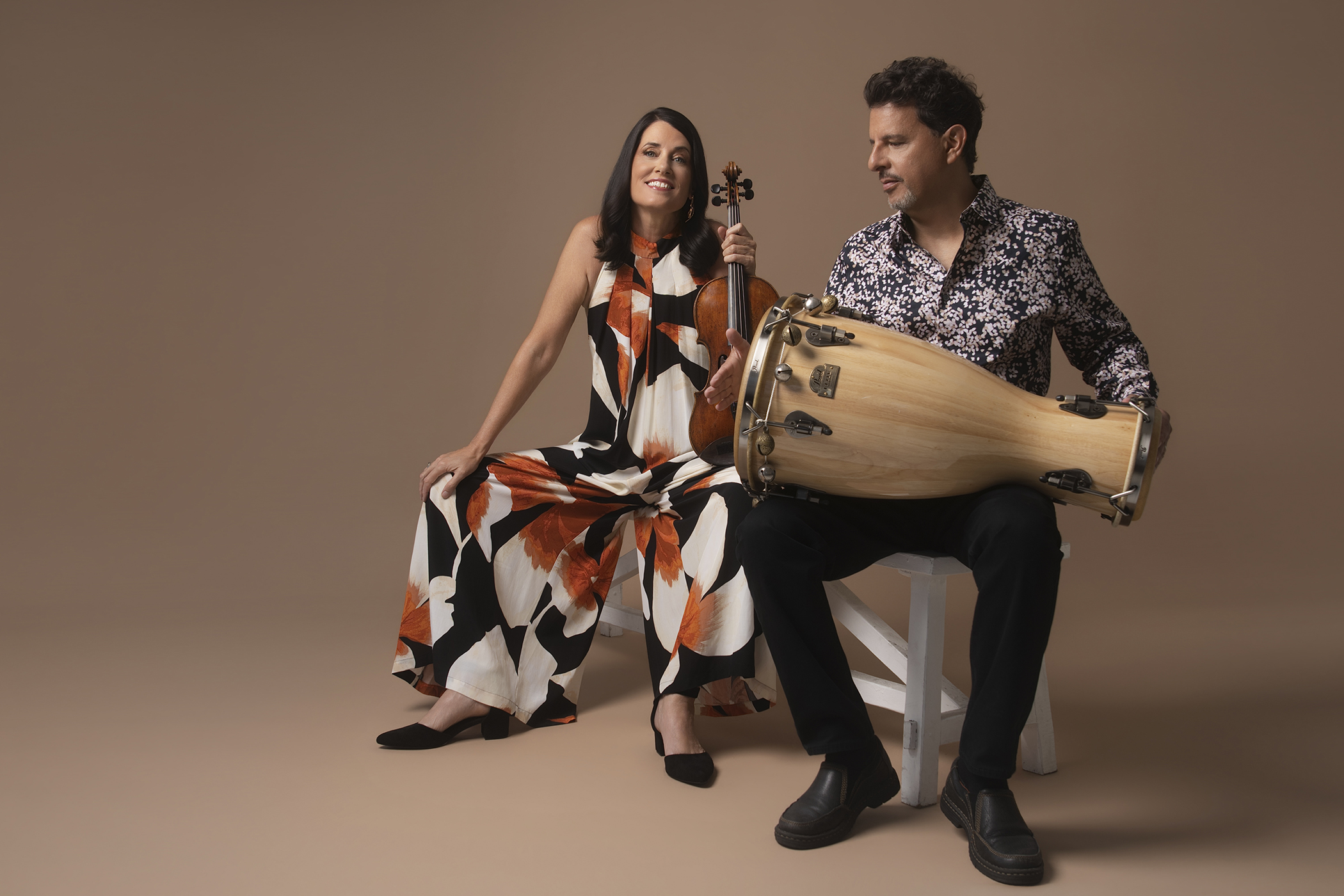
Pictured Above: Kathryn Lockwood and Yousif Sheronick. Photo Credit: Matt Dine.
Voices of America: Concordia Chamber Players Celebrates the American Musical Tapestry in Bucks County
By: Lori Goldstein
Concordia Chamber Players celebrates the many voices shaping American music with “Voices of America,” its October 18 season-opening concert in Solebury, Bucks County. Artistic Director and cellist Michelle Djokic brings together music by acclaimed American composers including Caroline Shaw, Jessie Montgomery, Philip Glass, John Corigliano and Kenji Bunch, alongside the distinctive sounds of duoJalal. In this Arts News Now feature, writer Lori Goldstein explores the stories, cultural influences and personal histories behind the program—and how classical music, folk traditions, film, improvisation and sounds from around the world come together to reflect what Djokic calls the “American fabric.”
For artistic director and cellist Michelle Djokic, there are no hidden agendas. As we converse about the Concordia Chamber Players’ October 18 season opener, she opens my eyes to why she titled the program “Voices of America.” In this year of the preeminent sesquicentennial, the fate of Voice of America (VOA), the international broadcaster established by the U.S. government in 1942, looms large.
“Certainly I wanted to recognize the significance of such a huge anniversary. But it’s somewhat bittersweet in my mind as a musician, that I’ve seen so many artists–colleagues and concepts, efforts made for generations—put to sleep, if not completely negated by the current political situation,” says Djokic. “I want to go on record as memorializing what American voices are. My role, in my own heart, is to celebrate what it means to be an American citizen and [how] America is represented…[by] all the [contemporary] composers” in this concert.
One might say a DEI programming policy is openly championed by Djokic, herself the daughter of immigrant parents. Her entryway to “Voices of America” were the works of two female composers, Caroline Shaw and Jessie Montgomery—both Grammy Award-winners. “The reason I chose Shaw’s Blueprint was because it’s the blueprint,” the foundation on which “so many of our composers and artists have built, whether it’s Beethoven or Bach or Haydn or Thomas Morley—who knows, you know?…Depending on which country you come from or which nationality you [are], those blueprints were laid a long time ago.”
Shaw composed Blueprint for the Aizuri Quartet, “whose name comes from ‘aizuri-e,’ a style of Japanese woodblock printing that primarily uses a blue ink…known as Prussian blue. Blueprint takes its title from this…printing tradition as well as from that familiar standard architectural representation of a proposed structure: the blueprint,” writes Shaw. This piece began its life as a harmonic reduction—a kind of floor plan—of Beethoven’s String Quartet, Op. 18, No. 6…[It’s] also a conversation—with Beethoven, with Haydn (his teacher and the ‘father’ of the string quartet).”

Pictured Above: Michelle Djokic. Photo Credit: Contributed.
Referring to Montgomery’s Strum, in which the string quartet holds and strums their instruments as if they were guitars, Djokic says Montgomery’s joyful composition harkens back to American folk music, and more specifically Black folk music. Djokic notes the “rhythmic strength that is in all of her music, that I’m sure she heard in her youth. That’s, for me, her ‘blueprint.’” Montgomery writes that in addition to the American folk idioms, “the quartet draws on the spirit of dance and movement, [its] narrative begins with fleeting nostalgia and transforms into ecstatic celebration.”
No presentation of contemporary American music would be complete without the work of legendary composer Philip Glass. His intimate Buczak Quartet was commissioned by Geoffrey Hendricks to memorialize his partner, the artist Brian Buczak, who at age 32, succumbed to AIDs-related complications. In his Substack column Michael Corigliani II writes that Buczak was a prolific artist: 400 paintings, 800-plus drawings, and an independent printing press for artists he founded with Hendricks. The Quartet premiered at New York City’s Hauser Gallery July 4, 1989, the second anniversary of Buczak’s death.
Composer John Corigliano, perhaps best known for his score for The Red Violin, “has done so much work in the film industry. His music encapsulates what it means to be telling a story through music,” says Djokic, who points out that music written for film is a genre born in this country. She posits that “there was less stigma against composers to write music for film,” which resulted in “a lot more freedom and creativity on the part of the American composers, many of whom were immigrants that came to work in L.A.”
The story of Corigliano’s Snapshot: Circa 1909 is based on a photograph of his father, playing the violin when he was eight years old, his teenage brother Peter standing beside him, strumming the guitar. (John Corigliano Sr. would become concertmaster of the New York Philharmonic.) In this one-movement quartet, the second violin plays a nostalgic melody representing his father as a boy. Then the first violin enters in the very highest register, “playing the dream that my eight-year-old father must have had—of performing roulades and high, virtuosic, musing passages that were still impossible for him to master,” writes Corigliano. “The two violins, boy and dream, join together at the end as the guitar sounds play on.”

Pictured Above: Kathryn Lockwood and Yousif Sheronick. Photo Credit: Matt Dine.
Two names that may be unfamiliar to the Concordia listening family are Japanese-American violist/ composer Kenji Bunch, and Yousif Sheronick, a Lebanese-American percussionist/composer. Sheronick and his wife, Australian violist Kathryn Lockwood, will join Concordia Chamber Players Michelle Djokic on cello, Siwoo Kim and Isabelle Durrenberger on violin in the October Concordia Chamber Players in the October 18 concert.
I learned about the above-mentioned composers in conversation with Lockwood and Sheronick, known as the performance ensemble, duoJalal. What struck me immediately was their home studio backdrop, shelves crammed with percussion instruments acquired from around the world. “And then he has this cupboard over here—all toys like shakers and bells, things that clang,” says Lockwood.
Lockwood was a member of the Pacifica Quartet in Chicago when she met Sheronick, of the New York-based Ethos Percussion Group in 1997. Both were attending an APAP (Association for Performing Arts Professionals) conference. Despite their itinerant careers, they were able to sustain a long-distance relationship and married several years later. Besides performing as duoJalal, they’re artistic directors of the Telluride MusicFest, a chamber music festival in Colorado, as well as the ensemble-in-residence for the Four Seasons in Music Chamber Music Series at Sands Point Preserve on Long Island.
I was curious about how they came to the realization that they could “marry” their instruments to form duoJalal. Sheronick explains that Lockwood was working on a CD of the music of Inessa Zaretsky. Since one more piece was needed to completed the CD, Zaretsky suggested writing a piece for the two of them. After Sheronick demonstrated a few different types of percussion instruments, they settled on hand drums. “We started performing this piece, Dervishes: Five Pieces for Viola and Percussion, and it was always the favorite piece of the program,” he says.
Lockwood states that they’ve performed probably the first piece ever written for the two instruments, the 1960 Sonata for Viola and Percussion, composed, ironically, by Australian Peter Sculthorpe—at the Australian Chamber Music Festival. They will record it on their third CD in December.
Since viola/percussion repertoire was practically nonexistent, they began reaching out to friends and colleagues they were playing with to try to get more music. A dinner party at the home of violist Toby Appel initiated duoJalal’s friendship with violist/composer Kenji Bunch. Bunch had so many questions about different percussion instruments that “we thought he seems like a composer that could actually write us a really good piece,” recalls Lockwood. In 2009, they commissioned him to write Lost and Found, a four-movement piece; duoJalal will perform its second movement, Found Objects, for the Concordia audience.
For percussion, Bunch chose the djembe, “the very big and loud West African [hand drum] that would normally not be able to be played with a viola, because it’s so intense,” explains Sheronick. “So what I decided to do, and since it’s called Found Objects, [found objects meaning the use of non-traditional everyday items to create sound] I found a different way to play the djembe, almost like a jazz drummer—with these brooms [Sheronick holds up two stickless brooms], like the ones you hang by your fireplace. I didn’t invent this, I saw somebody else doing it so I’m not claiming it.” And Lockwood recalls Bunch got the idea to use a djembe when he saw someone busking playing a djembe at a subway station.
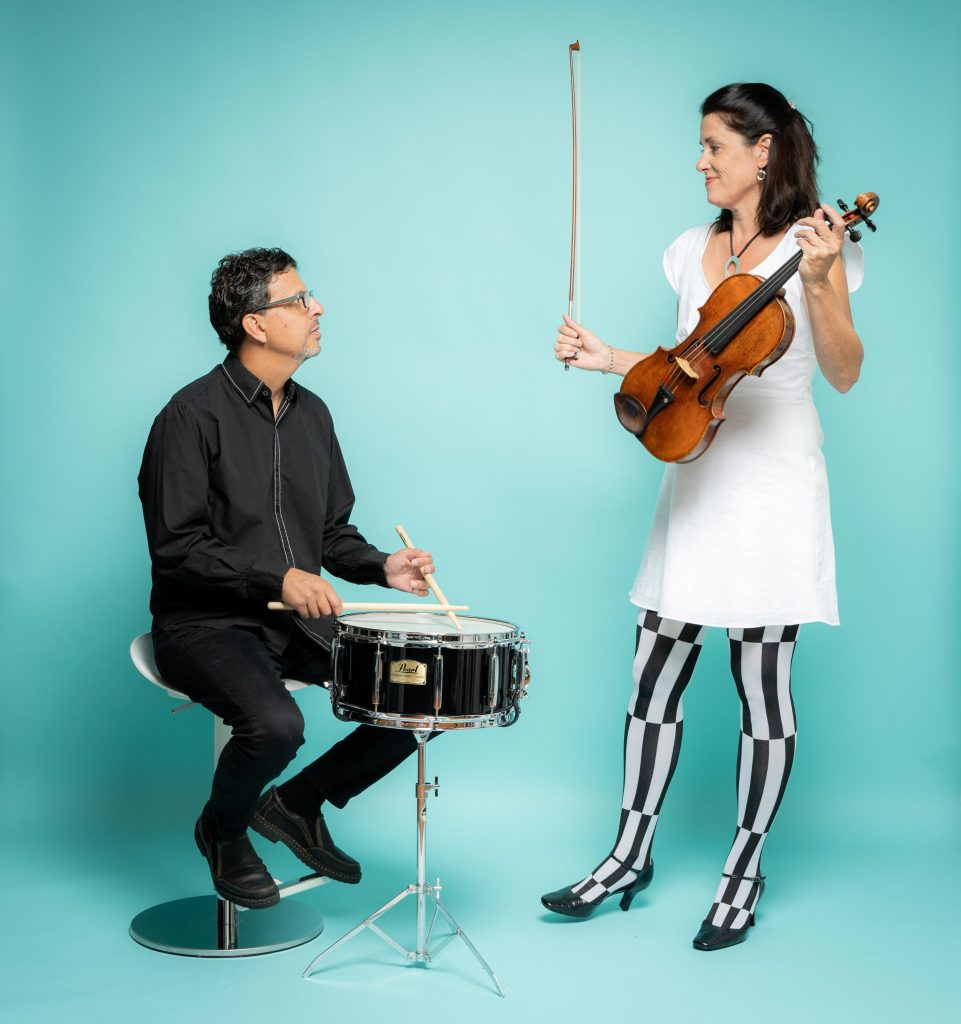
Pictured Above: Kathryn Lockwood and Yousif Sheronick. Photo Credit: Matt Dine.
Lockwood points out that her ‘found object’ is a guitar pick, and she holds her viola like a guitar when performing the movement. “It was really challenging to learn how to play with a pick without getting a lot of tension in my hand.” Then several years later, [I] saw Kenji play the piece without a djembe, just by himself at a viola congress in Rochester, and he just used his fingers. I said, ‘Hey, what about the pick?’ And he said, ‘It was too difficult,’” she jokingly recalls. In three of the four movements, Bunch asks for scordatura, or alternative tuning, of the strings; in Found Objects the scordatura results in the viola sounding like the kora, a West African 21-string instrument.
Lockwood muses on the title Lost and Found as a pun. “When we first commissioned this, Kenji was really excited, and then he realized how difficult it was to write for viola and hand percussion. It’s one of those things where composers don’t quite know where to start. And so he felt very lost. And then he found himself. So that’s the play on the title. It was a slower process than he thought it was going to be.”
A later work by Bunch, Megalopolis, led Djokic to seek out duoJalal. The Lark Quartet, in which Lockwood played, commissioned Megalopolis with Sheronick on percussion in 2016, then recorded it in 2019. He offers this image: “It’s like he drove through this large swath of Los Angeles and listened to all these different styles and put them all together.” Bunch writes that “the piece acts as a musical meditation on the mingling influences of our increasingly interconnected world and the fallacy of the Eurocentric ideal of pure Western culture.”
Megalopolis employs a variety of percussion instruments, including a Middle Eastern tambourine known as a riq, the conga drum, and the hourglass-shaped bata. “One of Kenji’s inspirations was Fela Kuti, a very big Nigerian star,” says Sheronick. Kuti’s Afrobeat was built on the West Ghana genre known as high life music. Juxtaposed against the offbeat rhythmic drive of Afrobeat is the unorthodox way Bunch writes for the string quartet: “the cello is used more like a double bass line, the middle voices are more like the backup singers, and the first violin is the more vocal line,” says Lockwood. “We’re trying to sound very much not like a string quartet.”
In addition to being a percussionist who’s toured not only with Philip Glass but his own quartet, Sheronick is a prolific composer, whose voice will be heard in duoJalal’s performance of Jubb Jannin. The work is named after the Lebanese village where Sheronick’s mother was born. Sheronick explains that he grew up in landlocked and very American Cedar Rapids, Iowa, where he played only rock and roll music and was in the marching band drum corps.
His earliest experiences of hearing music was his mother singing Lebanese folk songs. “She would always be inspired by a drone [a continuous unvarying tone], and that drone could be the sound of a vacuum cleaner. She would vacuum, hear a drone, and she’d start singing. Or we’d be in the back of the ’67 Buick, that eight-cylinder engine would hum, and she would start to sing these little folk songs. I wrote the piece based on those little melodies and that idea of a drone playing along with these melodies, and I wanted to play along with it. This is how it all started.”
Sheronick originally wrote Jubb Jannin for the ney, a Middle Eastern flute. “We adapted it for the viola. It’s set on a particular scale, and then I wrote a melody, which is not improvised. In Middle Eastern music, it’s called heterophony. They take a bass melody and embellish in and around it.”
“It’s almost like a jazz tune, where there’s a head, and then there’s a viola solo, or free improv, and a drum solo, and another head. That’s basically the form of the piece.” It’s played with a frame drum, based on a Moroccan instrument called the bendir, which he chose for the strings inside it that vibrate and serve as the drone.
There seem to be infinite opportunities for cross-pollination, the creative intersection of composers and musicians that make up what Djokic cherishes as “the American fabric.” In the late 1990s and early 2000s, Sheronick was touring with composer/pianist Philip Glass, kora player/vocalist Foday Musa Suso, and Jon Gibson on reeds. “Foday and Philip Glass wrote the music, and I basically got to create the percussion parts that I wanted to.”
He remembers one cab ride to the airport when he told Glass, “I have this duo with Kathryn. Is there anything you think we could play? He said, ‘Oh, I have a viola solo. As soon as I get home I’ll send it to you.’ So he extracted this viola solo, it wasn’t actually written for us. And he said, ‘I think you’ll do a really great job. Go ahead and create a percussion part however you feel fit.’ So I did that, then he renamed it Duo for Solo Viola and Percussion.” [View Youtube video.]
Lockwood herself has had a close professional relationship with composers Shaw and Montgomery, having invited each of them as artist-in-residence at the Montclair State University immersive residency program she coordinates. Speaking about Montgomery’s Strum, Lockwood says “I love its non-classical approach, the way it takes the quartet and refocuses the sound world.”
“Shaw’s philosophy on composing is that the music’s already out there,” says Lockwood. “She just puts it down on paper. So these fragments that she hears in her head, she likes to put them on paper, but in her own voice. It’s really exciting to see the string quartet genre taken into a different place.” As more forward-looking ensembles like duoJalal commission new pieces, the voices of America will continue to be heard. Join the Concordia Chamber Players audience on October 18 to enjoy this tapestry of breathtakingly beautiful music.
Concordia Chamber Players: “Voices of America”
When: Sunday, October 18, 2026 at 3 p.m.
Where: Trinity Church, 6587 Upper York Road, Solebury, PA
What: Concordia Chamber Players’ season-opening concert, “Voices of America,” celebrating American composers and the diverse musical traditions that have shaped contemporary American chamber music.
Free Open Rehearsal: Saturday, October 17, 2026, 2:30–4 p.m. at Solebury Friends Meeting, 2680 North Sugan Road, New Hope, PA.
Tickets are available through Concordia Chamber Players.