Independent Arts News Reporting
Pictured Above: The Sebastians. Photo Credit: Grace Copeland.
“Love and Ruin”—The Sebastians Make Their Philadelphia Chamber Music Society Debut with Baroque Cantatas Featuring Soprano Lucy Fitz Gibbon
By: Lori Goldstein
Baroque brilliance meets emotional storytelling as The Sebastians make their Philadelphia Chamber Music Society debut with soprano Lucy Fitz Gibbon. In her feature, Lori Goldstein explores how the ensemble’s program “Love and Ruin” brings fresh vitality to centuries-old works.
I’ve had two recent opportunities to attend concerts by the celebrated baroque ensemble, The Sebastians. The first was a performance in May 2024 of Purcell’s opera Dido and Aeneas, with The Sebastians sitting center stage, while the singers were choreographed to move around them. The second was at the Princeton Festival this past June, when they brought their program, “Baroque Brilliance” to Trinity Church. In both concerts, I was struck by their energy, both physical and emotional, in conveying the joy in the music of which they are such skillful masters.
When their harpsichordist Jeffrey Grossman told me they would be making their debut with the Philadelphia Chamber Music Society (PCMS) October 19 at the American Philosophical Society’s Benjamin Franklin Hall, I expressed interest in having a conversation with him about the upcoming concert. I also had the pleasure of speaking with soprano Lucy Fitz Gibbon, renowned for her interpretation of baroque as well as contemporary vocal music, who will solo with The Sebastians in two cantatas. They have performed together in years past, and Ms. Gibbon is a PCMS returnee.
The concert’s title, “Love and Ruin,” captures the plight of two heroines whose cantatas (solo vocal works with instrumental accompaniment) are the cornerstone of their program, which will also be performed in The Sebastians’ popular NYC Concert Series. Speaking of the French baroque composer Michel Pignolet de Montéclair, Gibbon says, “We don’t hear a lot of Montéclair’s music in the United States. We hear much more of the German and Italian and even English baroque than we do the French baroque, and I have been interested in his work for a number of years.” Montéclair’s La Morte di Lucretia (1728) and Handel’s Armida abbandonata (1707) provide an interesting contrast. “We have two very different but strong women, women who wind up on the outskirts of society for various reasons, and we meet them both at really critical junctures,” says Gibbon. “I thought that this juxtaposition of the two works, which were written at a similar time to each other, but which have very different sound worlds, was an interesting opportunity.”
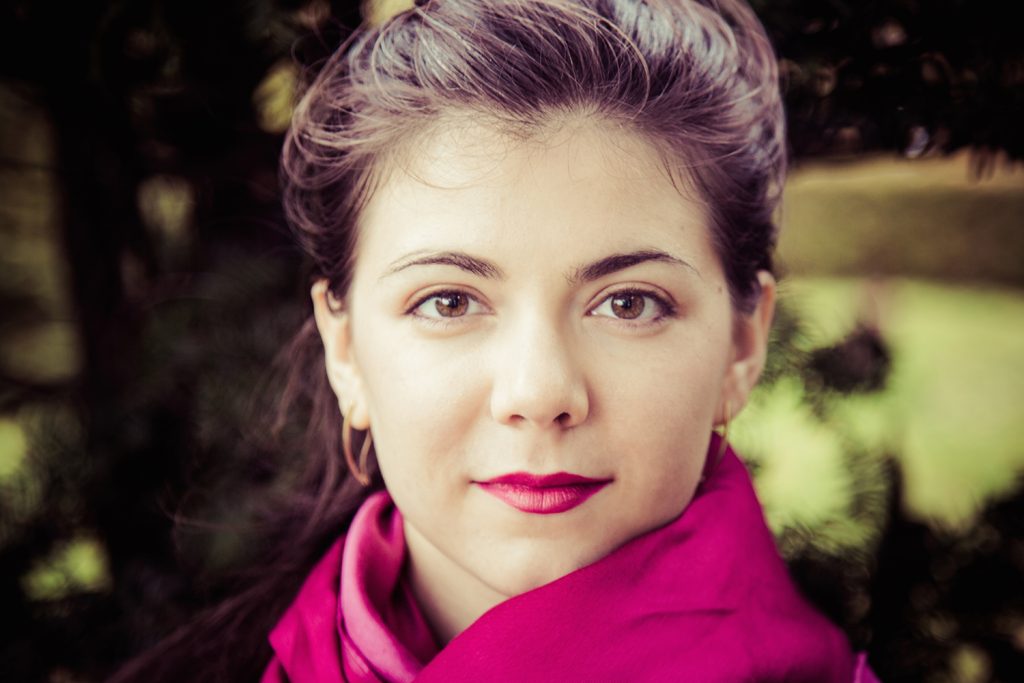
Pictured Above: Lucy Fitz Gibbon. Photo Credit: Bellatrix Photography.
Montéclair’s cantata, based on Livy’s Annals of Rome, recounts the legend of Lucretia, a Roman daughter and wife, who is raped by the son of King Tarquinius Superbus. Since her honor has been defiled, she believes she must end her life. Her husband Collatinus, father, and friend Lucius Junius Brutus avenge her by provoking an uprising that leads to the end of monarchy and the birth of the Roman republic. Handel’s Armida, based on Tasso’s epic poem Gerusalemme liberate, is a sorceress who loves the knight Rinaldo. Armida is no tragic heroine, yet she becomes a victim of love when Rinaldo escapes her enchanted island.
“I love this period of Handel’s musical output,” says Gibbon. It coincides with an edict that the pope issued forbidding the composition of opera, believing that a recent earthquake was God’s way of expressing anger, and the culprit must be opera. Accordingly, Handel turned to composing unstaged vocal works, including cantatas and oratorios. “He could be creative musically in these smaller forms in a way that was maybe a little bit harder than when he was writing for the stage and needing to sell tickets.”
“What I have found interesting in Handel’s work is that he really writes out some of the ornamentation that he’s intending, so one of the movements is quite slow, but the musical notation, essentially the ornamentation that I’m singing is very detailed, and so it’s interesting for me to see how he’s constructing that,” says Gibbon. “I think there’s a little more room for interpretation in the Montéclair. Stylistically that period will get indications that a certain ornament should happen, or there is an opportunity for ornamentation which is often indicated with a little plus sign. But in this piece we don’t see as much of that written out.”
The Handel is all from Armida’s perspective, displaying her range of emotions from heartbroken grief to angry vengeance. “In the Montéclair I go back and forth between being a narrator and then stepping into Lucretia’s shoes,” says Gibbon. “And there’s a sort of moralizing that happens that is a little disturbing from a contemporary perspective, insofar as it’s explained to us that her honor has been lost and she has basically no other recourse, while also praising her for taking this action. It’s a little bit different from how we would hopefully think differently about women in the 21st century, but it also provides food for thought. It finishes with this somewhat strange button at the end that [makes it] almost like an Aesop’s fable. We get this very short moral at the end, and all of a sudden we find ourselves in this major cadence, which feels so incongruous given the pathos that just happened before it.”
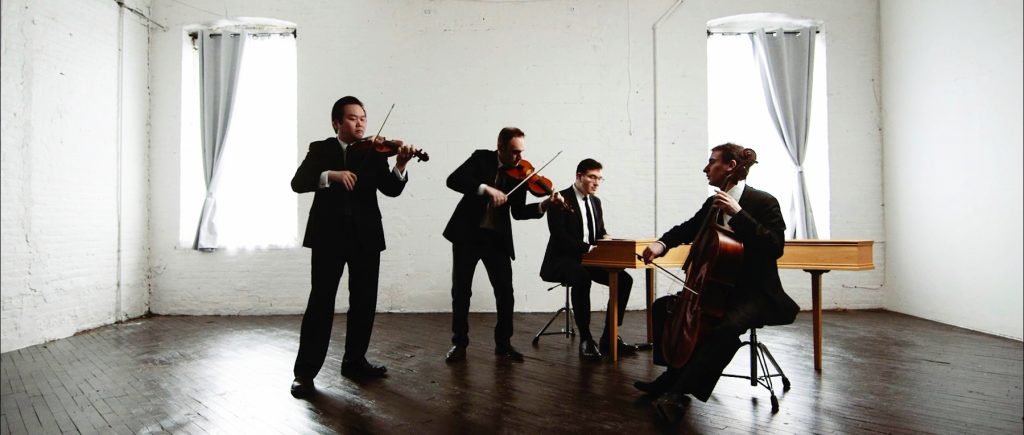
Pictured Above: The Sebastians. Photo Credit: Four/Ten Media.
A careful selection of trio sonatas, the baroque’s instrumental precursor to the string quartet, complements the cantatas. The Sebastians—the core quartet of violinists Daniel Lee and Nicholas DiEugenio, cellist Ezra Seltzer, and harpsichordist Jeffrey Grossman—perform throughout the concert. Grossman explains that the program shows “the way that the Italian style spread outwards, especially to France. We have a little taste of that in the sonata by Elisabeth Jacquet de la Guerre and the Montéclair cantata…Montéclair of course was French but writing in Italian, and writing in this Italian cantata style. The cantata as a small-scale form really started in Italy, and then the French got really interested in it, so they wrote hundreds of cantatas after that. Even the writing for the violin, it was really the Italians who were writing. It all started in Italy, the way that people wrote for the violin, and then it dispersed.”
Ironically, the earliest work on the program, Sonate No. 9 (1629) by Dario Castello, stipulates that it be performed in stile moderno. Grossman believes the modern style refers to the improvisatory character of Castello’s writing: “structures move from one thing to another almost capriciously. You might have a very beautiful slow recitative-like section followed by a crazy dance, followed by something totally different, and they’re not particularly balanced. They happen like a stream of consciousness…with quicksilver-like changes.” What is striking in this sonata are the four separate lines—the continuo line in the harpsichord, the two violin parts, and the emergence of the cello as sometimes an independent voice, and often a voice equal to that of the violins.
Corelli’s Trio Sonata Op. 3, No. 2 (1689) might be viewed as a corrective to such unfettered composition. “What I love about Corelli is he was coming out of this period when things were free and structures were a little bit less clearly defined,” says Grossman. “Corelli set everything in order. We now go back and classify them as a church sonata or a chamber sonata, and they all fit this mold really well. The alternation of slow and fast movements—that was something that you found in that time, but it wasn’t as widespread. Corelli solidified things both structurally and also harmonically. His music feels so right, the way that the progressions move, the way that the harmonies move. His use of harmony was really influential on later music.”
Handel’s Trio Sonata Op. 5, No. 1 (1739) has a lot in common with Corelli’s. They have similar structures, though Handel is playing with that structure when he adds a fifth movement, a dance form known as a gavotte. “Handel studied in Italy and was really influenced by Corelli [who] was the god of instrumental music at that time. So the way that Corelli wrote for the violin really influenced Handel,” says Grossman. “I think Handel is maybe a little bit more, I mean coming after the model, he’s a little bit more prone to have fun with it, to subvert your expectations a little more. So where Corelli is wonderfully familiar, Handel has these moments of delight and surprise—like the gavotte that we don’t expect.”
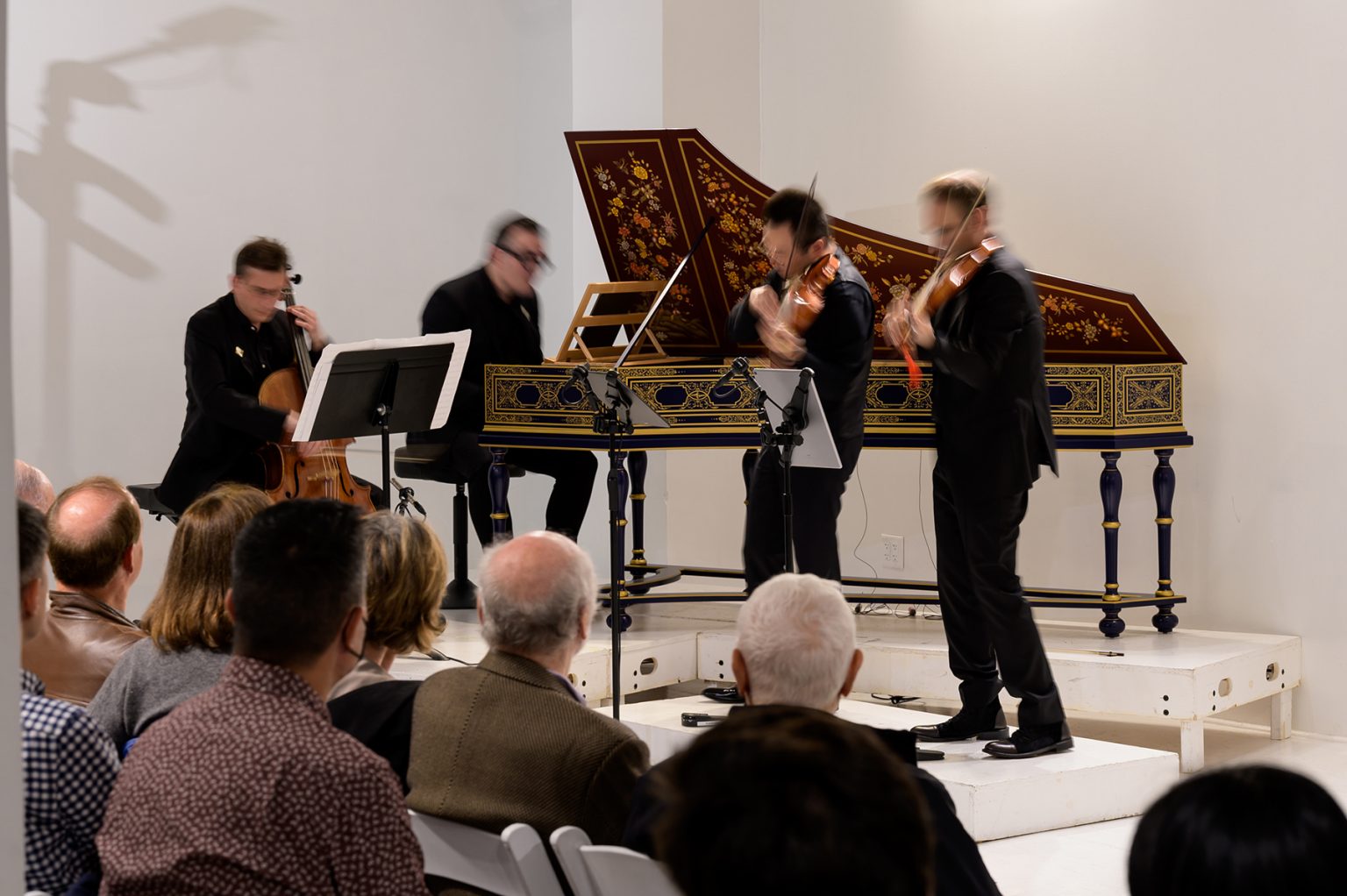
Pictured Above: The Sebastians. Photo Credit: Grace Copeland.
Elisabeth Jacquet de la Guerre was a child prodigy who played the harpsichord for Louis XIV. She was also the first woman to compose an opera in France. “What she’s known for is mixing the Italian style of writing with the French harmony and ornamentation. Her violin Sonata No. 1 (1707) has some of the free form nature of the Castello even though it’s a hundred years later,” says Grossman. “Some of the sections are only three bars long, then she moves on to another idea. Even the word sonata, which she uses, is an Italian word. The French word would have been sonade, the Italian style was so in vogue in France in the early 1700s, that we thought it would be an introduction to the Montéclair… In one sense you could say this sonata is in Italian by a French composer, or at least it has a little bit of an Italian accent.”
“Love and Ruin” concludes with Vivaldi’s La Follia (1705), the 12th and final movement of his Suonata da camera a 3, Op. 1, No. 12. “It’s one of the oldest themes that we know, that may have even come from the New World, perhaps Mexico, this harmonic progression that probably started as a guitar progression in the late 1400s,” explains Grossman. “Armida abbandonata ends so devastatingly sad, but her character shows so many emotional complexities that we thought it would make sense in the context of that.”
Our discussion of pieces brand new to me made me curious about the resurgence of interest in the music of the baroque, or early music, period, which dates back from 1600 to 1750. Grossman attributes this in part to the current generation of musicians’ mastery of the replicas of old instruments on which they play. “The violins use gut strings that are hard to play in tune…For a long time, performers struggled with consistency, with making beautiful sounds. Especially in the last 20 years, the level has gotten so high that I think that’s become less of a hindrance, and then we get back to finding what makes this music speak, the emotions behind baroque music of course haven’t changed at all in the last 300 years, and while a lot of this music has continued to be performed for that time, I think the colors that we get from baroque instruments add a freshness, a vitality that seems to grab audiences.”
Much library research goes on behind the scenes of early music performances. Baroque players study manuscripts and read treatises. “They might argue about whether a slur [a notation indicating two or more notes be played in one smooth direction of the bow] goes to the first note or the third note, but then at the end of the day, we’re trying to make it sound like it was written yesterday, like the ink is still fresh on the page. And that’s a lot about taking the library work and doing that, and then throwing it all out–and going out and playing with all our heart and as committed as we can,” says Grossman.
Tickets to the October 19 concert are available at pcmsconcerts.org.